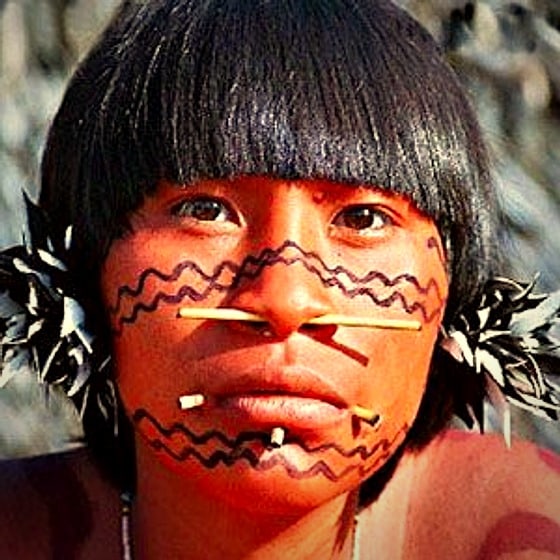
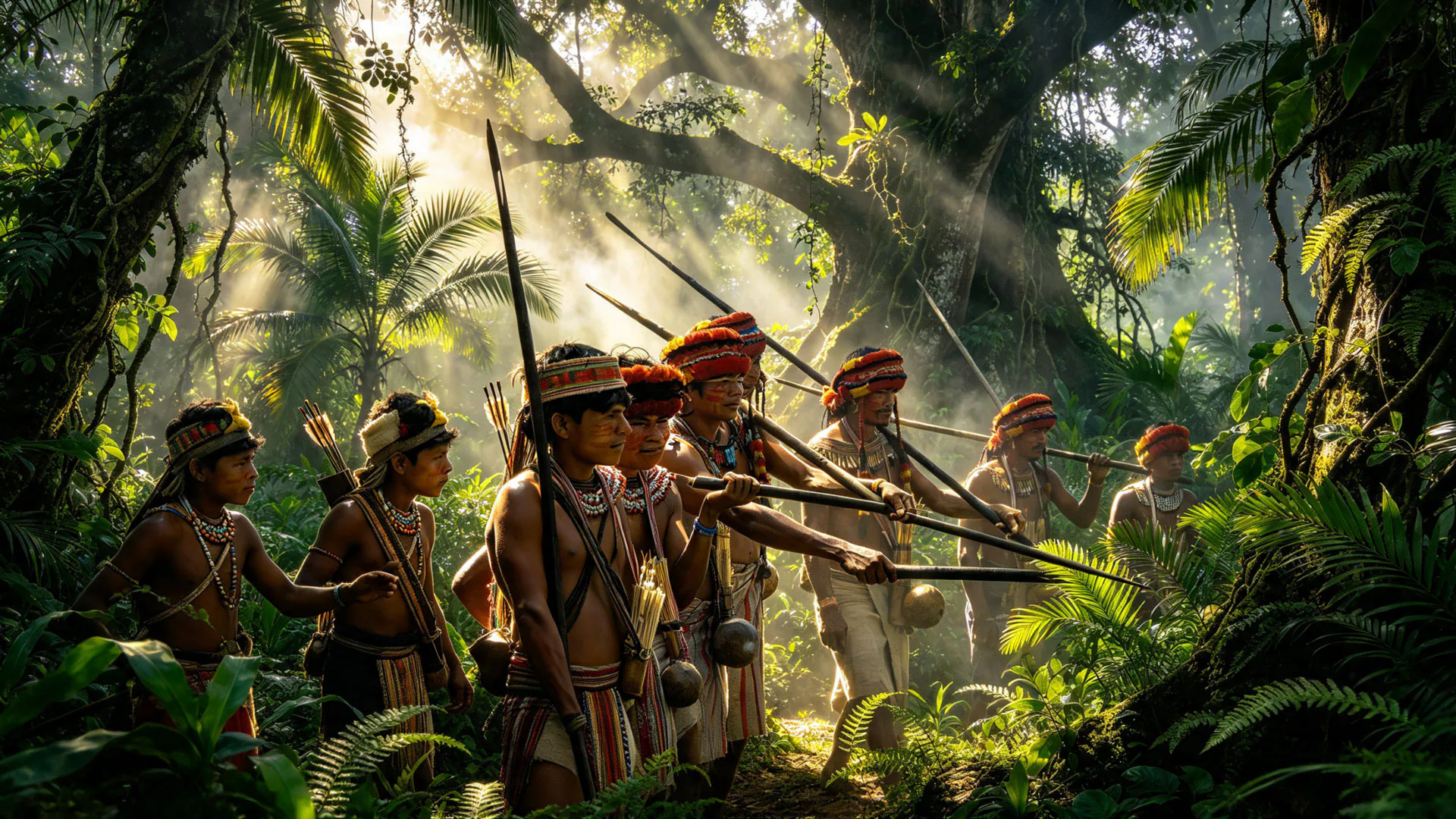
The Jivaro people, who call themselves the Shuar, live in the western part of the Amazon basin, on the border of Ecuador and Peru, in the valleys of the Pastaza, Morona and Santiago rivers. It is estimated that on the Peruvian side of the border alone there live about 30,000 members of this people, who today are engaged mainly in farming, hunting, fishing and gathering forest fruits.
In the past the Shuar were a markedly warlike people, and conflict and vengeance between kin groups largely shaped the life of the community. They believed that a slain enemy acquired a powerful, avenging soul, and that the only way to neutralize that soul was for the victor to take the head of the defeated, skin it and work it into what is called a tsantsa – a shrunken head, which was then buried in the ground or thrown away in the forest, by which, it was believed, the soul itself was also set free.
Large communal houses of wood, lianas and leaves survive to this day, in which as many as forty members of an extended family may live; the society is polygamous. They are also known for a special alcoholic drink that the women prepare by chewing cassava root – enzymes in the saliva start the fermentation of the spat-out liquid, which thus becomes mildly alcoholic. In hunting, blowguns are still used with darts dipped in a strong plant poison, and from the feathers of the birds they catch they make striking ornaments and caps.
Tsantsa – the shrunken head
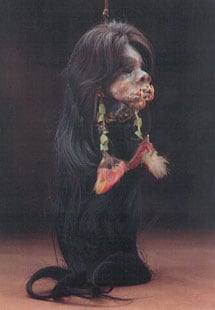
The making of a tsantsa was a lengthy and carefully devised process. The skin of the head, together with the hair, was first separated from the skull and then dried with smoke and with hot pebbles or sand that were put inside the skin and moved about, until the head had shrunk to a size much smaller than a fist, while the hair, staying the same length, made its appearance all the more frightening. According to tradition, the magical power that the tsantsa carried also depended on the long fast that the warrior who owned it then underwent.
Ethnologists place this custom in the wider family of warrior rituals connected with the head and hair of a defeated enemy – a similar symbolism, in the much simpler form of removing the scalp, is found in the tradition of scalping among the North American Indians, where the hair was likewise regarded as the seat of a person’s life force.