The Nazca culture developed in southern Peru, in the region that today bears the name Ica, and was closely linked with the older Paracas culture, while in time it existed alongside the Moche on the northern coast. It reached its height between roughly 100 BC and AD 600.
Settlements were built along the upper courses of rivers which, for lack of water, often dried up before reaching the Pacific. To secure water in such a dry environment, the Nazca, like other coastal cultures of the time, built branching underground aqueducts – a system that called for a serious knowledge of hydraulics and is partly still in use today.
Society seems to have been governed by priests who were versed in astronomy, calculation and geometry. On painted pottery they are shown being carried in litters by thin servants, which points to their high standing. Their prestige probably also rested on their ability to “read” the sky and predict the change of the seasons – in that context a calendar of 360 days attributed to this culture is also mentioned.
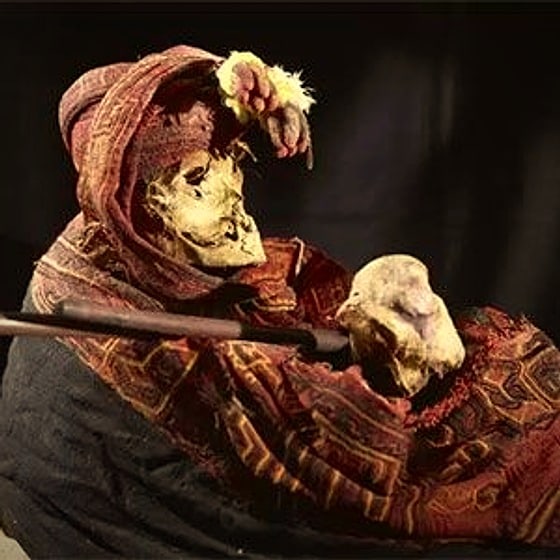
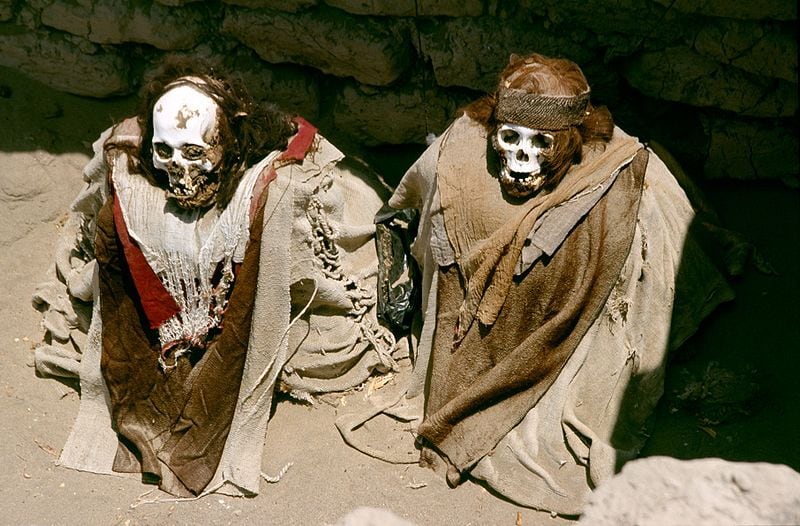
The graves discovered in the region show that the burial rite was of great importance. The most distinguished dead were buried in elaborate tombs, furnished with pottery, textiles, gold jewellery and feather headdresses for the journey to the other world; in the same complexes the remains of people assumed to have been sacrificed were also found, including the bones of children. Ordinary inhabitants were buried more simply – in pits, in a sitting position and without grave goods.
Pottery
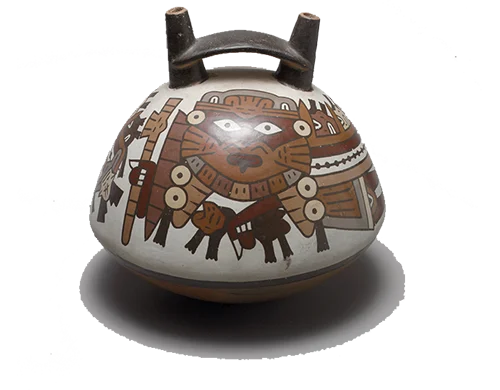
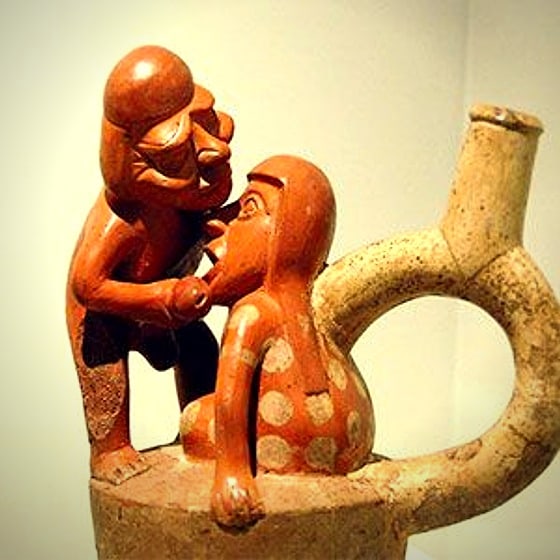
Archaeologists count Nazca pottery among the finest in the whole of pre-Columbian America. It was made by modelling the clay on a convex base, and its recognizable shape – a rounded body with two tubular spouts joined by a bridge handle – sets it easily apart from the pottery of other Andean cultures.
The decoration was varied: from geometric patterns (lozenges, circles, triangles) to plant, animal and human motifs. Especially notable is the figure of a being with a feline face from whose mouth snakes emerge, as well as the many depictions of severed human heads, which lead some researchers to assume that head-hunting had a place in the beliefs of this culture.
The Nazca Lines
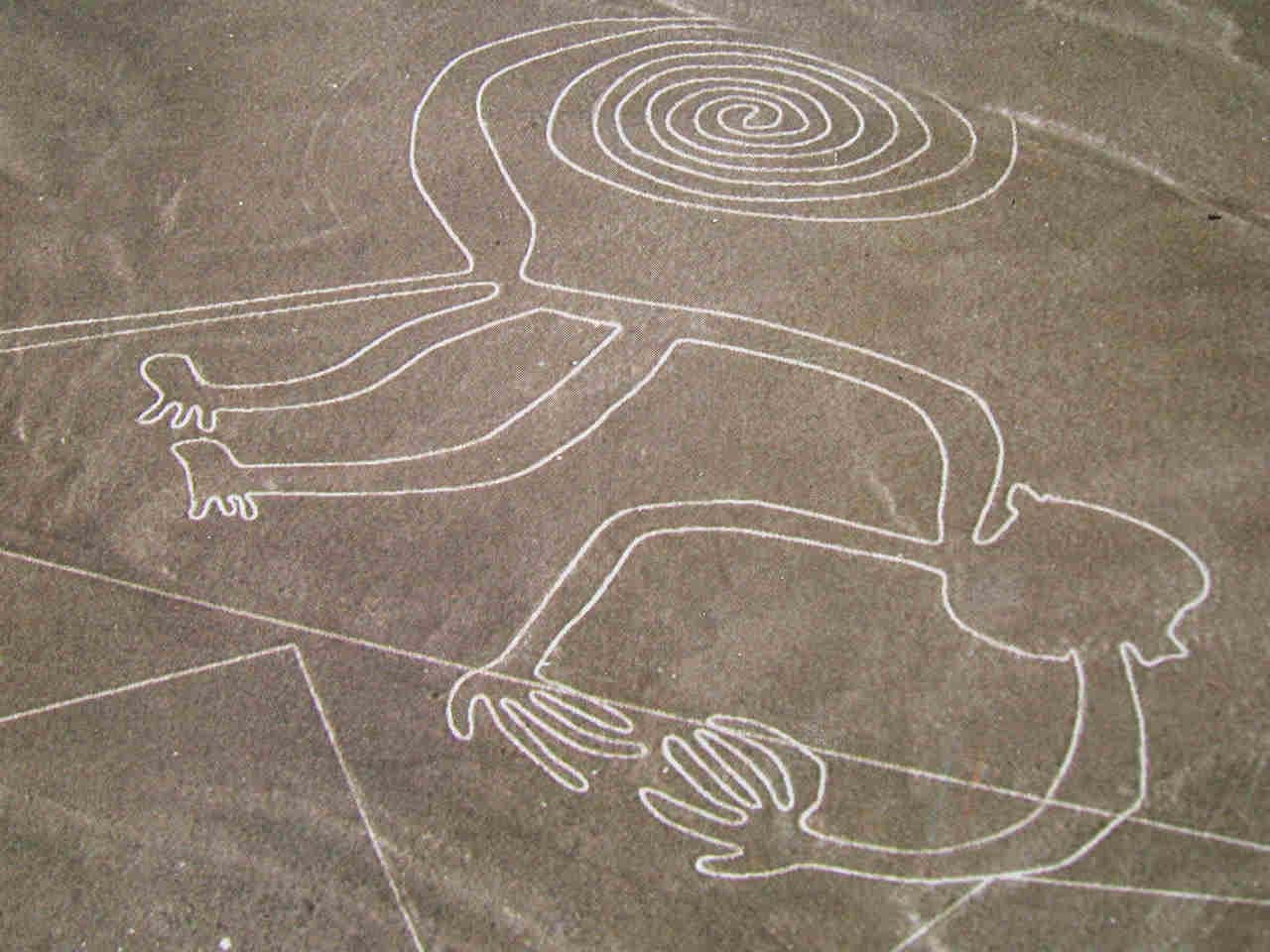
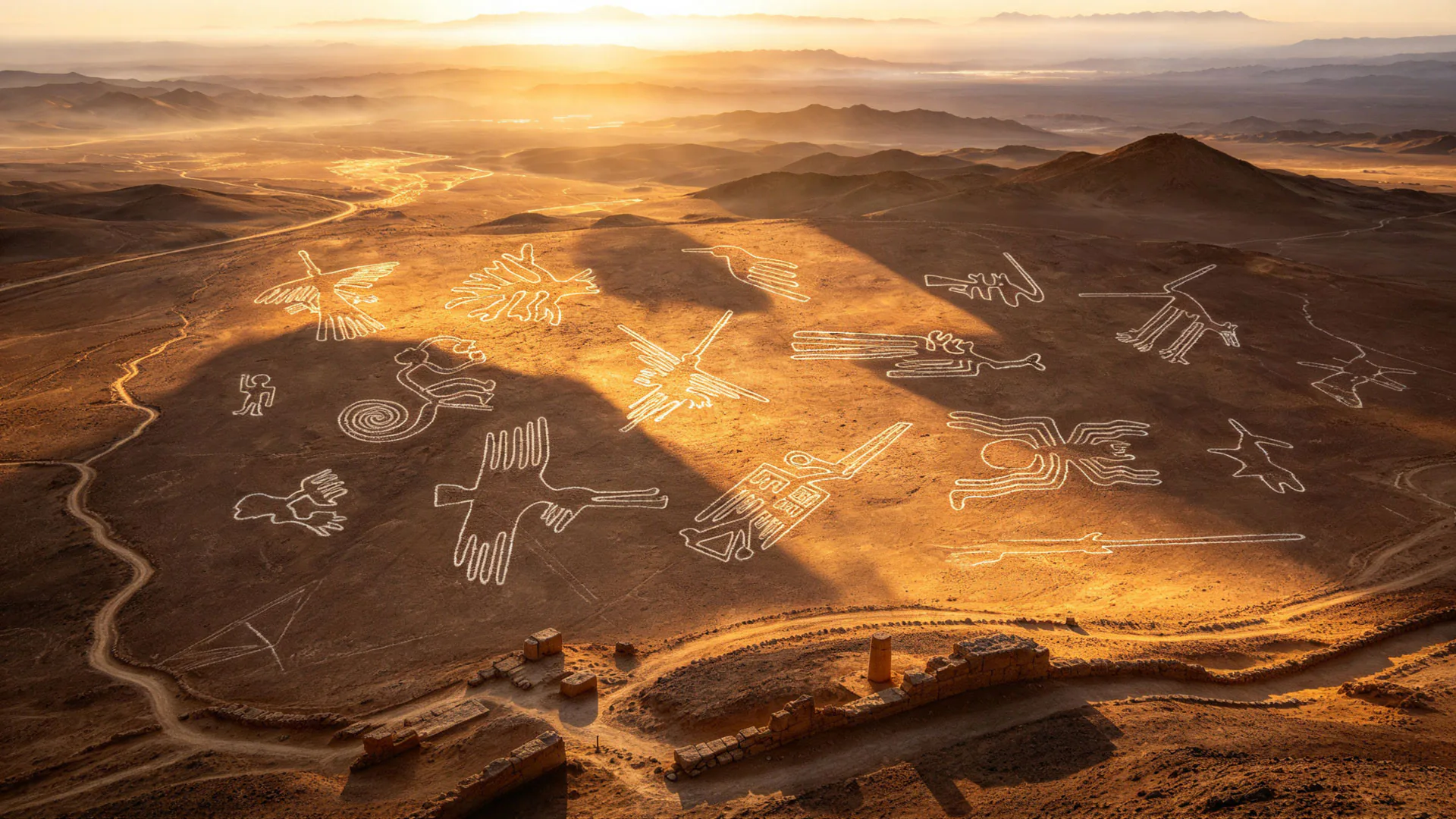
The best-known legacy of this culture is certainly the geoglyphs in the desert of the Pampa de Nazca (or Pampa del Ingenio), huge drawings cut into the ground that bear witness to a deep knowledge of astronomy. They were first described in 1926 by the Peruvian archaeologist Toribio Mejía XesspeThe Peruvian archaeologist who was the first to record scientifically the existence of the lines in the Nazca desert, although they had been known to the local population before., and decades later their study was continued by the German mathematician Maria Reiche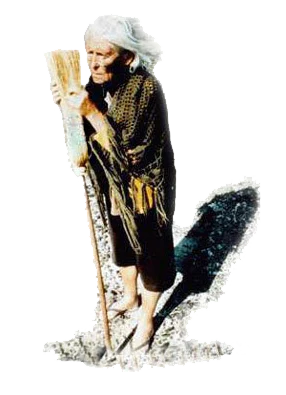 Maria Reiche (1903–1998). A German mathematician who spent most of her life in the Nazca desert, studying and protecting the geoglyphs. She is buried near the lines she studied..
From the 1940s onwards Reiche spent years measuring and mapping the lines and came to the conclusion that the largest of them served as a kind of astronomical calendar, tied to the change of the seasons and the position of the heavenly bodies. In one place, for example, she found that as many as 23 straight lines branch out from a single point, and that one of them points to the position of the Sun at the equinox. For a people whose survival depended on scarce and precious water, following such cycles had a thoroughly practical value as well.
The geoglyphs depict birds (a pelican, a gull, a heron, a condor, a parrot, an egret), then a spider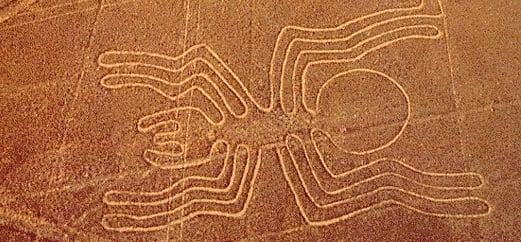 The spider One of the better-known geoglyphs in the Nazca desert., a snail, a monkey and several reptiles (a lizard, an iguana, a snake), and a dog, two llamas, a whale and one large shape resembling a candelabrum can also be made out. Some lines are barely a metre wide yet run for kilometres, while certain animal figures reach a length of up to 300 metres. They were made by removing the dark, iron-stained top layer of the ground, exposing the lighter, yellowish layer beneath.
Despite decades of work by researchers, including Reiche, who devoted most of her life to them, the exact purpose of the Nazca Lines is still a matter of conjecture, and they continue to be regarded as one of the great riddles of ancient America.