Tiwanaku is one of the oldest and most enigmatic Andean cultures, whose name is tied to the site of the same name on the Bolivian shore of Lake Titicaca, at a height of about 4,000 metres. Its flowering is usually placed between the 9th and 12th centuries AD, although estimates of the age of the ruins, as we shall see, were long a matter of dispute.
Serious scholarly interest in Tiwanaku arose at the beginning of the 20th century, when the Polish researcher Arthur PosnanskyA Polish engineer and archaeologist who studied Tiwanaku at the beginning of the 20th century. His estimate that the ruins are as much as 14,000 years old is now considered scientifically untenable, but it long fed popular theories of a “lost civilization”., working on the route of a railway in Bolivia, came upon the remains of the ancient city. On the basis of astronomical calculations, Posnansky estimated that the ruins were as much as 14,000 years old – an estimate that later research did not bear out. A far more widely accepted view was put forward by the German ethnologist Max UhleA German archaeologist (1856–1944), one of the founders of modern Andean archaeology, who put the dating of Tiwanaku on a far more realistic chronological footing., according to whom the bulk of the remains dates from between the 9th and 10th centuries AD – a dating closer to the one accepted by specialists today.
At its height Tiwanaku was a city of about 20,000 inhabitants. It is assumed that at first it had a primarily religious role, like sites such as Chavín de Huántar or Pachacamac, and then developed into a centre of craft production as well – working bronze, cutting turquoise and making sumptuous pottery. The sheer size and precision of the buildings show that behind them stood an organized workforce, a clear division of labour and advanced engineering knowledge.
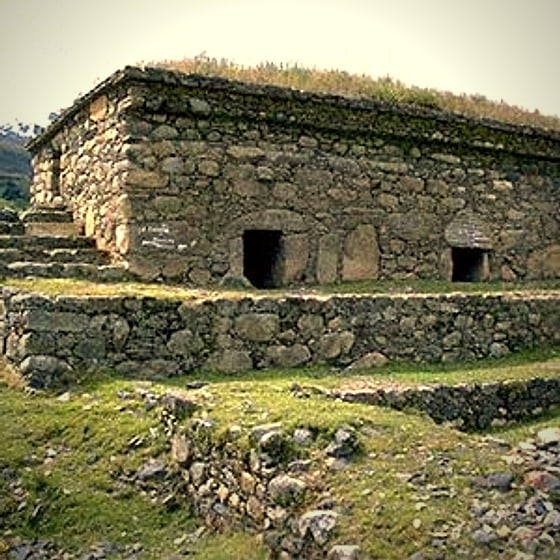
The remains of the city spread over a plateau about a kilometre long and some 450 metres wide. Most of the structures were built of massive stone pillars, between which rectangular blocks of dressed stone were laid, course upon course. Notable among the buildings is the Akapana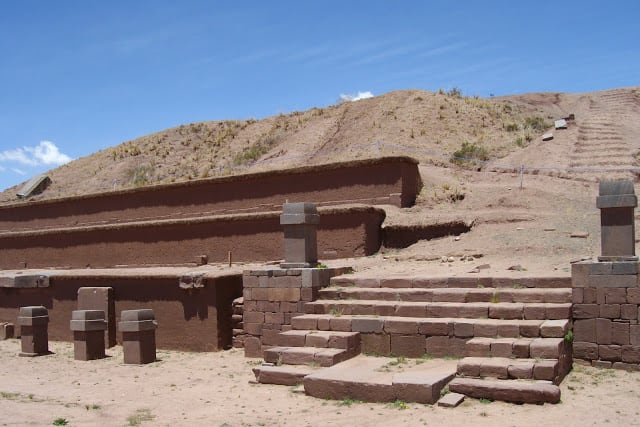 Akapana A stepped pyramid about 210 metres wide and about 15 metres high, which is assumed to have had a defensive function as well., a stepped pyramid believed to have had a defensive as well as a ritual role. Since this is a dry region, the city had a branching system of masonry channels for collecting water and bringing it to the centre – all the more important because Tiwanaku, as a place of pilgrimage, received a constant flow of visitors.
The Kalasasaya and the Gate of the Sun
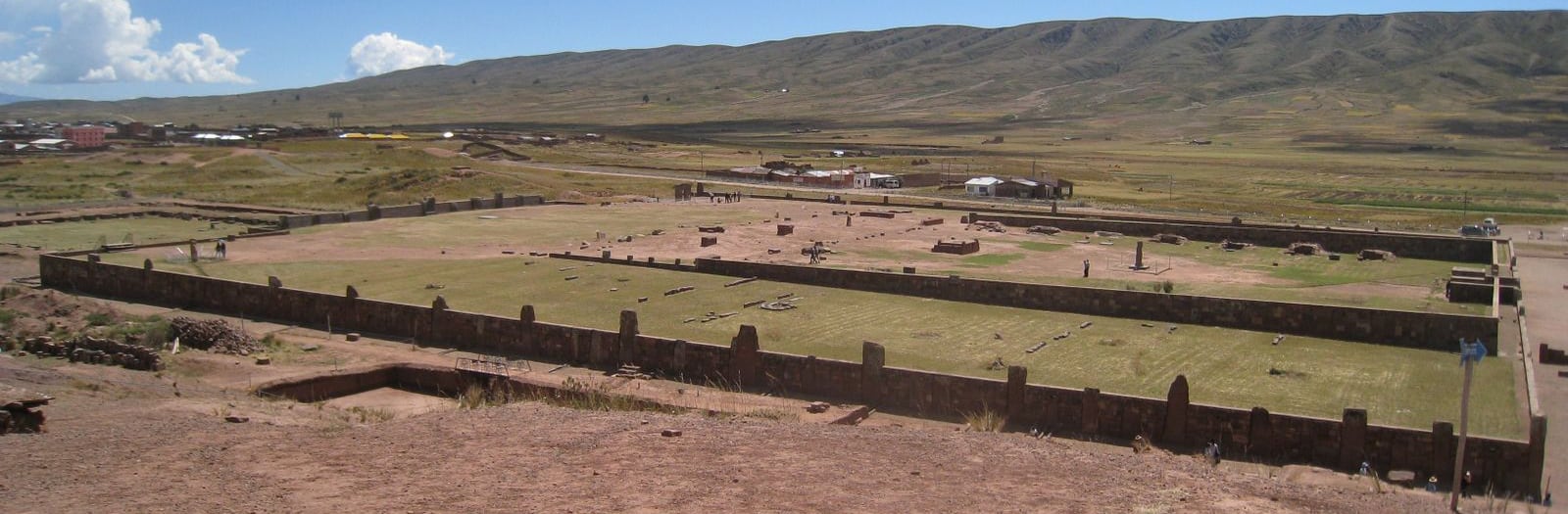
The best-known part of the site is the temple of the KalasasayaThe name in the Aymara language means roughly “place of the standing stones”, after the monolithic pillars that enclose the temple., a complex of about 1,755 square metres, enclosed by a row of upright monolithic pillars resembling menhirs. The Kalasasaya is thought to have served as a kind of astronomical observatory too, intended for following the movement of the Sun through the year. At its centre stands the Ponce Monolith, named after the archaeologist Ponce SanginésA Bolivian archaeologist (1911–2009) who led excavations at Tiwanaku for decades and after whom the monolith discovered at the centre of the Kalasasaya is named., who discovered it.
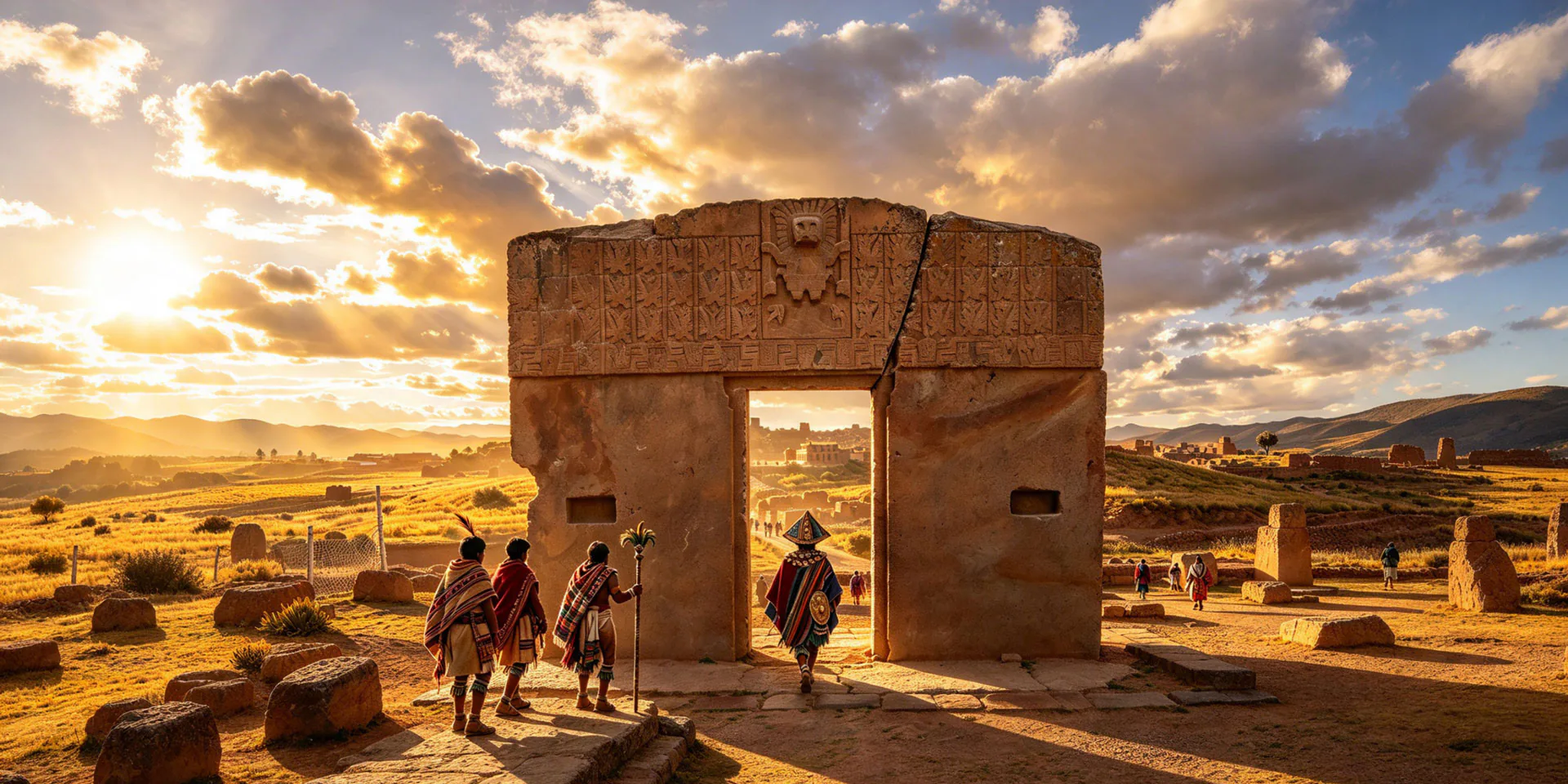
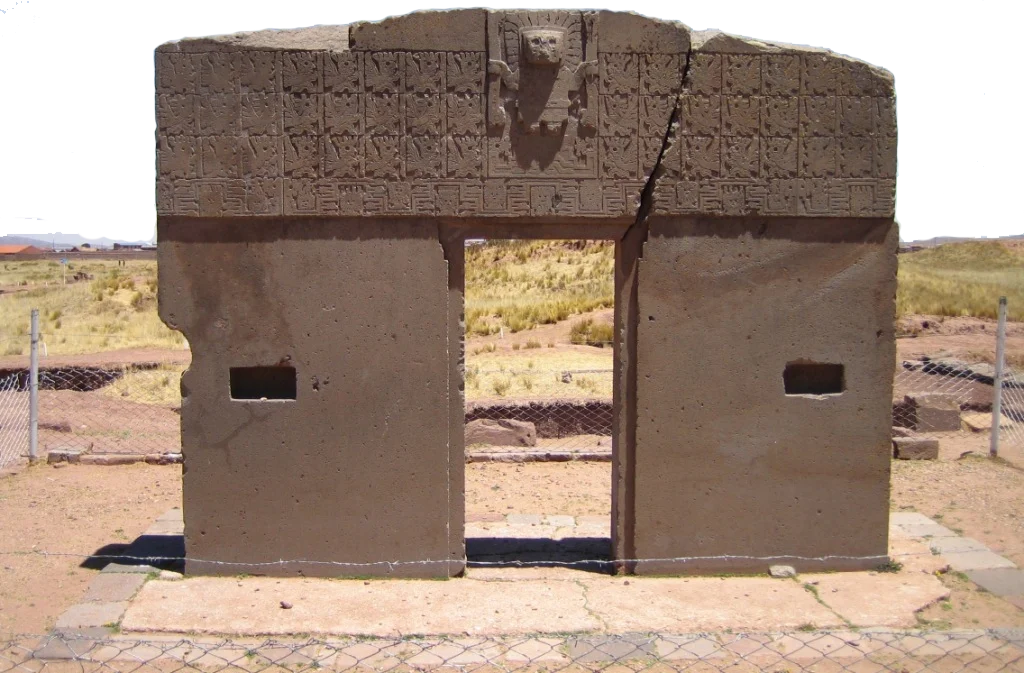
At one end of the temple stands the Gate of the Sun (Puerta del Sol), perhaps the most recognizable symbol of this culture and of its cult of the Sun. It is a kind of arched gateway, about two metres high and about four metres wide, carved from a single block of stone. At the centre of its upper slab is an anthropomorphic figure holding a staff in each hand, surrounded by three rows of smaller, winged beings arranged in a line. Most researchers believe that the central figure represents the god Viracocha, the creator of the world whose cult, like the influence of Tiwanaku culture itself, spread along the whole of the Andes and at one period intertwined with the Wari culture.