According to archaeological finds, the Caribbean islands were settled as early as about 5000 BC, when groups of hunters and gatherers occupied them. Only around the turn of the era do communities practising farming and pottery appear on the islands, newcomers from South America – probably from the Amazon valley, by way of the Orinoco delta on the coasts of Venezuela and Guyana, from where they spread through the Lesser Antilles to the Greater Antilles as well (Puerto Rico, the Dominican Republic, Cuba, Jamaica). All these groups spoke languages of the Arawakan family, and among them the greatest cultural development was reached by the Taíno, who shared the history of the islands with related peoples – the Ciboney, Ciguayo, Lucayo and Igneri – as well as with far more warlike newcomers, the Caribs.
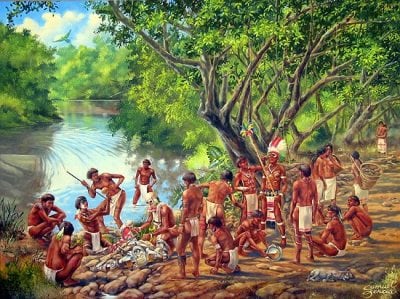
Social order
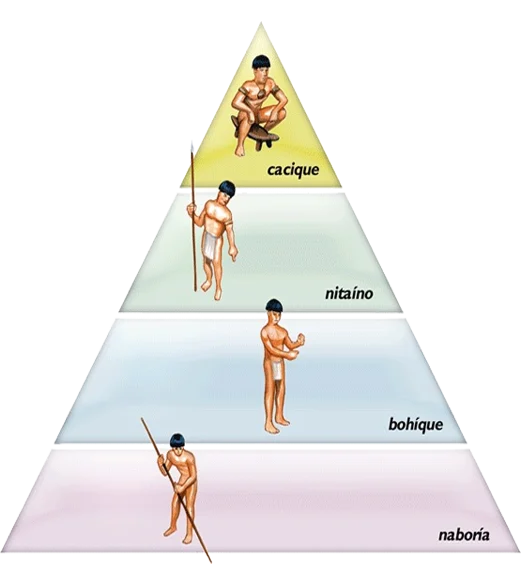
At the head of the community stood a chief, the cacique. Although there was no true social class, in the sense of control over the means of production, three layers can be clearly made out: the cacique himself; then the nitaínos, his close associates, relatives, caciques of lower rank and medicine men (behiques); and finally the common people. The cacique supervised work on the communal land and the distribution of the yield, while the accumulation of wealth was prevented by customs such as ritual feasts (areíto), at which, with music and song, the cacique or some event important to the community was celebrated.
The cacique enjoyed special prestige, could have several wives and held a kind of monopoly over religion, for the sacred idols were kept in his house; interestingly, the cacique could sometimes be a woman. Although the Taíno are often described as a peaceful people – an impression recorded by Columbus himself – the presence of prisoners of war in the cacique’s service as personal servants suggests that the warrior spirit was not entirely foreign to them, only far less pronounced than among the Caribs.
Settlements and farming
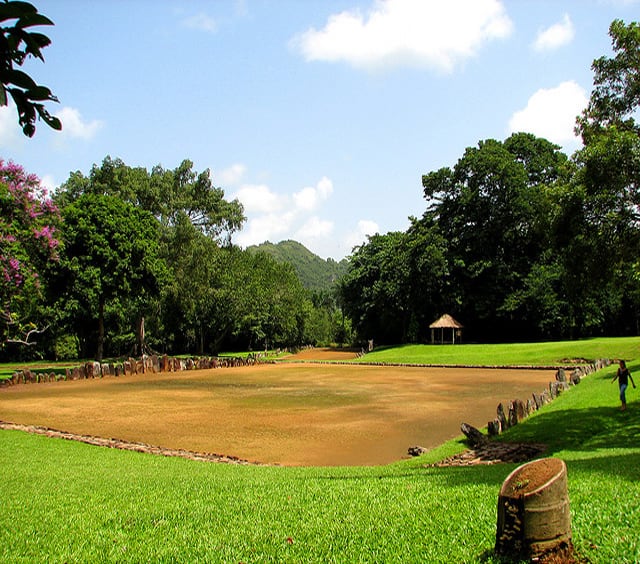
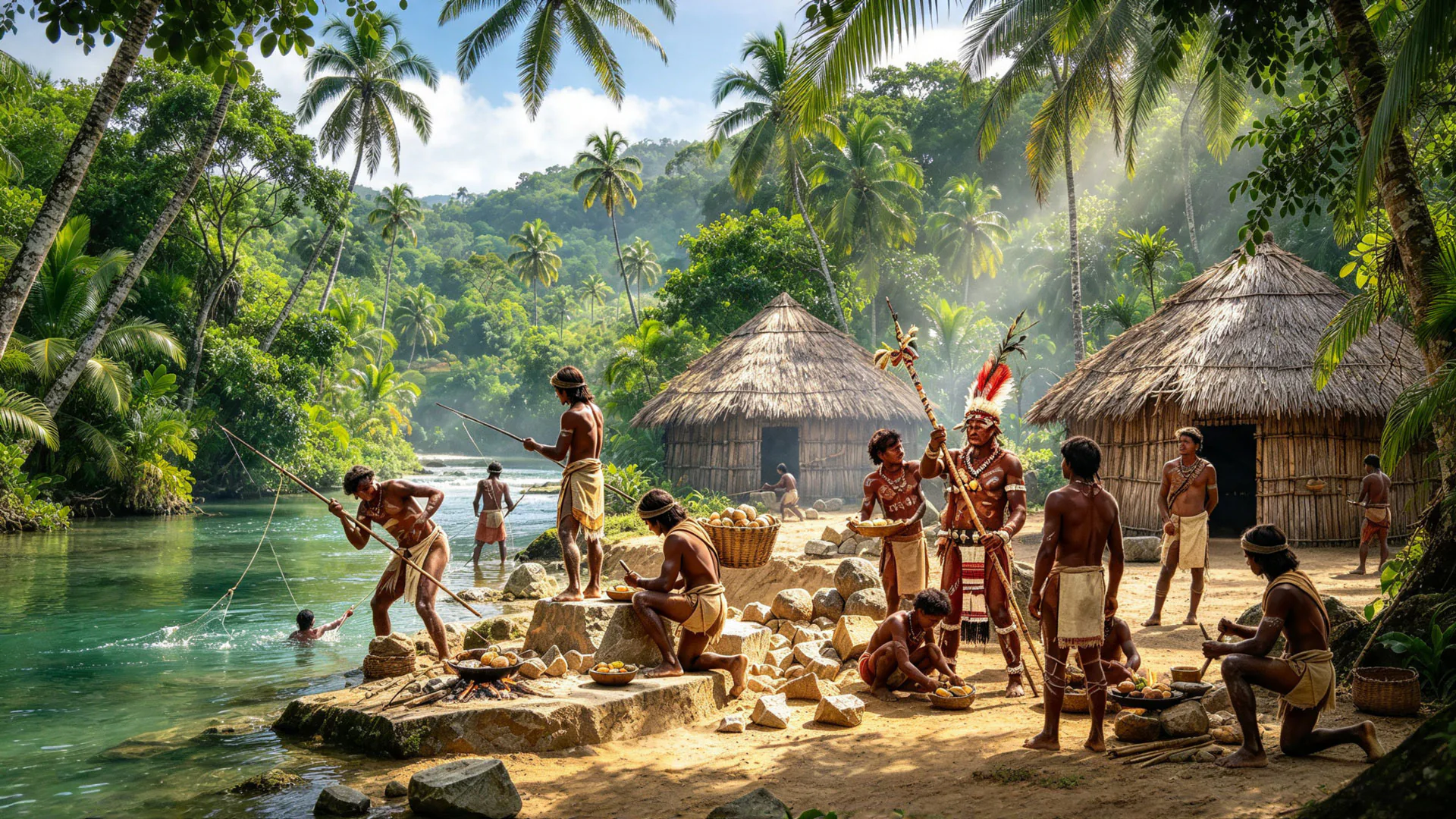
The size of the settlements varied, and according to some recent finds in the Dominican Republic a few may have had more than 5,000 inhabitants. The centre of communal life was the plaza, which the Taíno called the batey; larger settlements could have several plazas, round or rectangular, always bordered by stone slabs carved with petroglyphs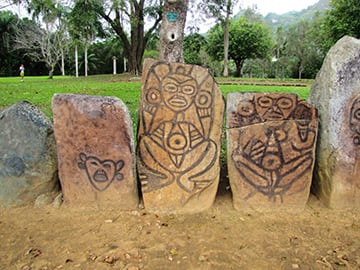 Petroglyphs The name comes from the Greek words petros (stone) and glyphein (to carve, to engrave)..
Around the plazas stood the houses: the ordinary family house, the bohío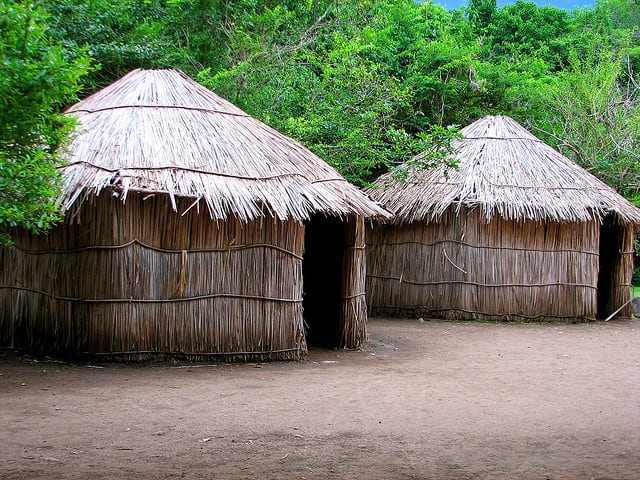 Bohío A family house with a circular ground plan, a conical thatched roof and walls of cane reinforced with wooden posts., had a circular ground plan and a conical thatched roof, with walls of cane and lianas reinforced with wooden posts and a single opening – the door. The cacique’s house (caney) was more spacious, rectangular in plan, with a gabled roof of palm leaves and an open porch. Settlements were built close to arable fields and sources of water; each was governed by its own cacique, and land for planting was cleared by felling and the controlled burning of chosen plots (conucos).
Magic also played an important part in farming: small stone figures were buried in the ground with a special rite, such as the three-pointed stone, a symbol of fertility which, according to researchers, recalled both the shape of the cassava root and a woman’s breasts, and whose purpose was to increase the yield of this staple crop. Objects in the shape of a petal or a teardrop, made of polished stone, were also left in the fields as offerings.
From cassava (manioc) the women made a bread called casabe: they removed the skin with the sharp edges of shells, then grated the pulp and squeezed it in a special spindle-shaped device (cibucán) to remove the root’s poisonous juice, before baking the dried mass. Their diet also included peppers, squash, peanuts and tropical fruit (papaya, pineapple, guava), as well as fish, which was sometimes caught by poisoning small stretches of water with the barbasco plant.
Religious ideas and beliefs
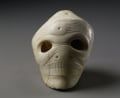
Most of what we know about the beliefs of the Taíno comes from the notes of the Spanish friar Ramón Pané, who wrote down their myths at the end of the 15th century. Theirs was an essentially animistic religion, in which deities embodied the forces of nature, plants, minerals and animals, and their guardians were represented by figures called cemís. Seizing another community’s cemí was regarded as a great humiliation for the community it belonged to. The supreme deity, according to Pané, was called Yocahu Bagua Maorocoti – the immortal and invisible creator and lord of the sky who, since the Taíno were above all a farming community, was also revered as lord of the harvest, of cassava, of water and of the sea.
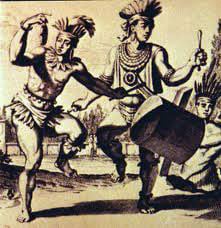
There were no special temples; religious life took place in the plazas, with the whole community taking part, and the most important rites were the ball game, the areíto celebration and the cohoba ritual. Little is known about the rules of the ball game, except that the ball could be struck with any part of the body but the hand and that the players wore belts and protective gear; the same game was popular in Mesoamerica too.
Unlike the areíto and the ball game, in which the whole community took part, the cohoba ritual was attended only by shamans and caciques, the only ones initiated into the secrets of communicating with the deities. Before the rite the body was deliberately purified by vomiting, with the help of a specially decorated spatula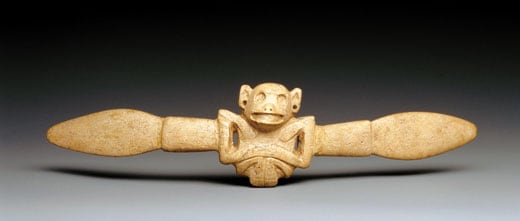 Spatula and spoon The spatula was used to induce vomiting in order to purify the body before the ritual, and the spoon to place the hallucinogenic powder on the cohoba idol., and then a hallucinogenic powder made from the seeds of the tree Piptadenia peregrina was inhaled through the nose with a special snuffing tube
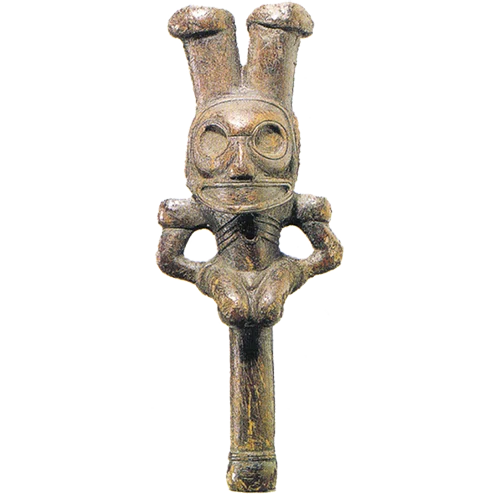 Snuffing tube A finely made device with which the shamans inhaled the hallucinogenic powder during the cohoba ritual.. After that the participant fell into a trance and, it was believed, made contact with the deities.
Deeply rooted, too, was the cult of the dead, along with the belief that the spirits of the dead wander at night and can take on the form of living relatives, differing from the living only in having no navel – a distinction that Taíno artists applied consistently in their depictions of people, showing the living with a navel and the dead without one. Burial depended on social rank: ordinary people were cremated or buried modestly, while caciques were laid in special burial chambers, in a sitting position, on low carved stools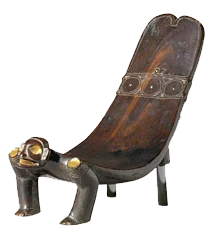 Duho A low wooden stool, the sign of authority of caciques and shamans. It was used in the cohoba and areíto rites, and its owner was buried on it after death. (duho) that symbolized their authority, surrounded by finely made objects of pottery.
Art
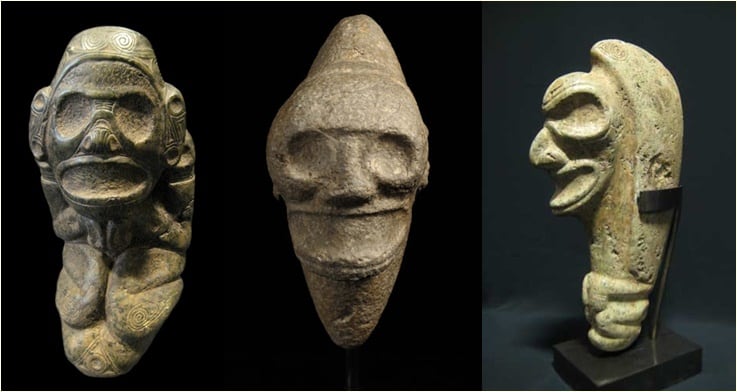
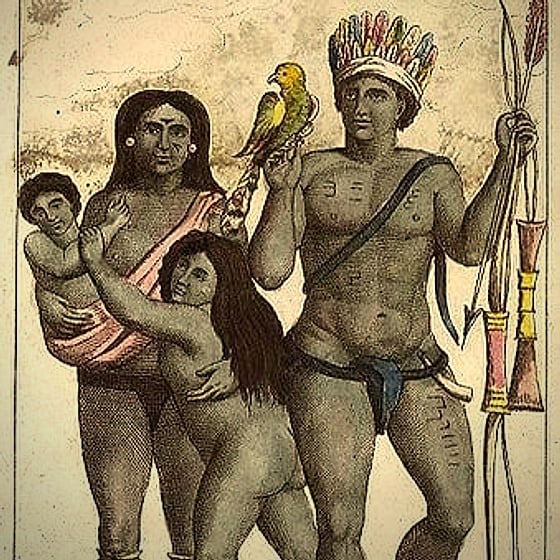
The Taíno made objects of pottery, stone, bone, shell, metal, wood and cotton cloth, developing a recognizable style in which the symmetry of the left and right sides of the figure played an important part, with the head enlarged in proportion to the body. Their favourite technique was incision, whatever the material, and the commonest motifs – frogs, bats, owls – come from their mythology. Their musical instruments were the conch-shell trumpet (pututo, also known in Mesoamerica and the Andes), rattles made of hard fruits, maracas of dried gourds and drums of hollow logs. For festivities they painted their bodies and wore amulets, bright feathers, shell necklaces and bands around their arms and legs.
The cacique Hatuey
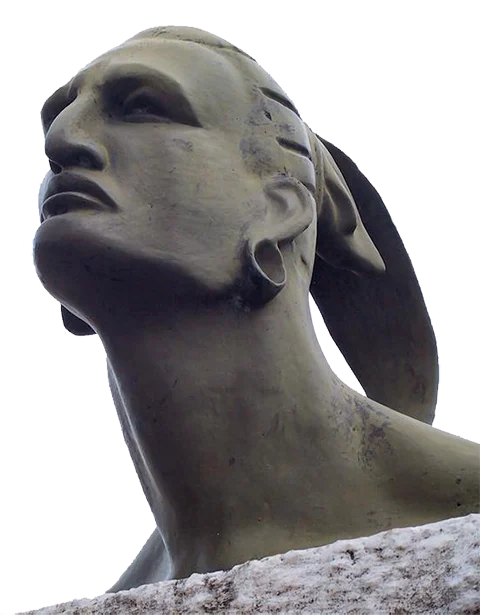
The cacique HatueyA Taíno chief from Hispaniola who organized resistance to the Spanish in Cuba. In Cuba and Puerto Rico he is regarded today as one of the first heroes of the resistance to colonization. fled before the Spanish conquerors from Hispaniola to Cuba with about a hundred followers and there organized a guerrilla resistance that lasted some three months, before he was captured and, by order of the governor Diego Velázquez, burned at the stake in 1512.
According to later testimony, while Hatuey was tied to the stake a Franciscan spoke to him of the Christian faith and promised him paradise if he was baptized before he died; when Hatuey asked whether there were Christians in that paradise and was told that there were, he is said to have replied that in that case he did not wish to go there, for he could not bear the company of such cruel people. That scene deeply shook the Franciscan priest Bartolomé de las Casas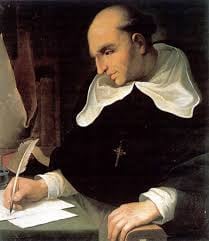 Bartolomé de las Casas (1484–1566). A Spanish priest, at first a participant in the colonization and then its fiercest critic and a champion of the rights of the native peoples of America., who after that event gave up all the estates and Indians he had held in his service until then and devoted the rest of his life to the struggle against the encomienda system and for the rights of the native population. In 1541 he published his famous work “A Short Account of the Destruction of the Indies”, in which he describes in detail and with horror the crimes of the colonists against the peaceful and hospitable peoples of America – a text which centuries later remained one of the most important testimonies to the scale of colonial violence in these lands.
The disappearance of Taíno culture
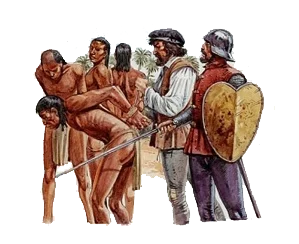
The arrival of the European colonizers at the end of the 15th century brought a cultural and biological catastrophe to the peoples of the Caribbean, the Taíno among them. The Spanish introduced the encomienda system – the obligation of the population to pay tribute in gold, produce or forced labour – which, combined with exhaustion and poor diet, left the native population extremely vulnerable to diseases brought from Europe, above all measles. Within a few decades the epidemics drastically reduced the number of Taíno, who were later replaced by slaves brought from Africa, while the surviving natives in time mixed with the colonists and the African population.