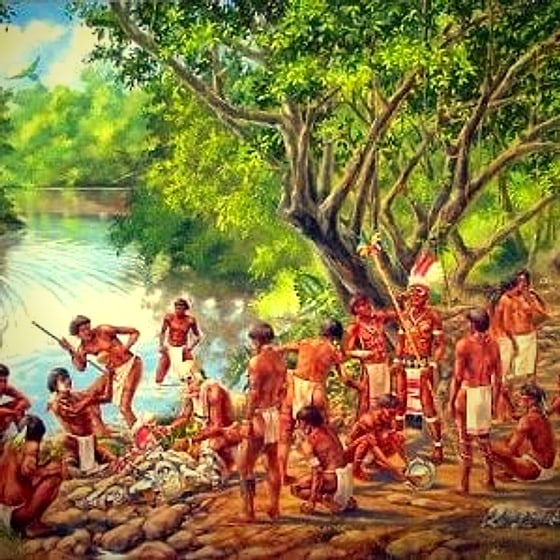
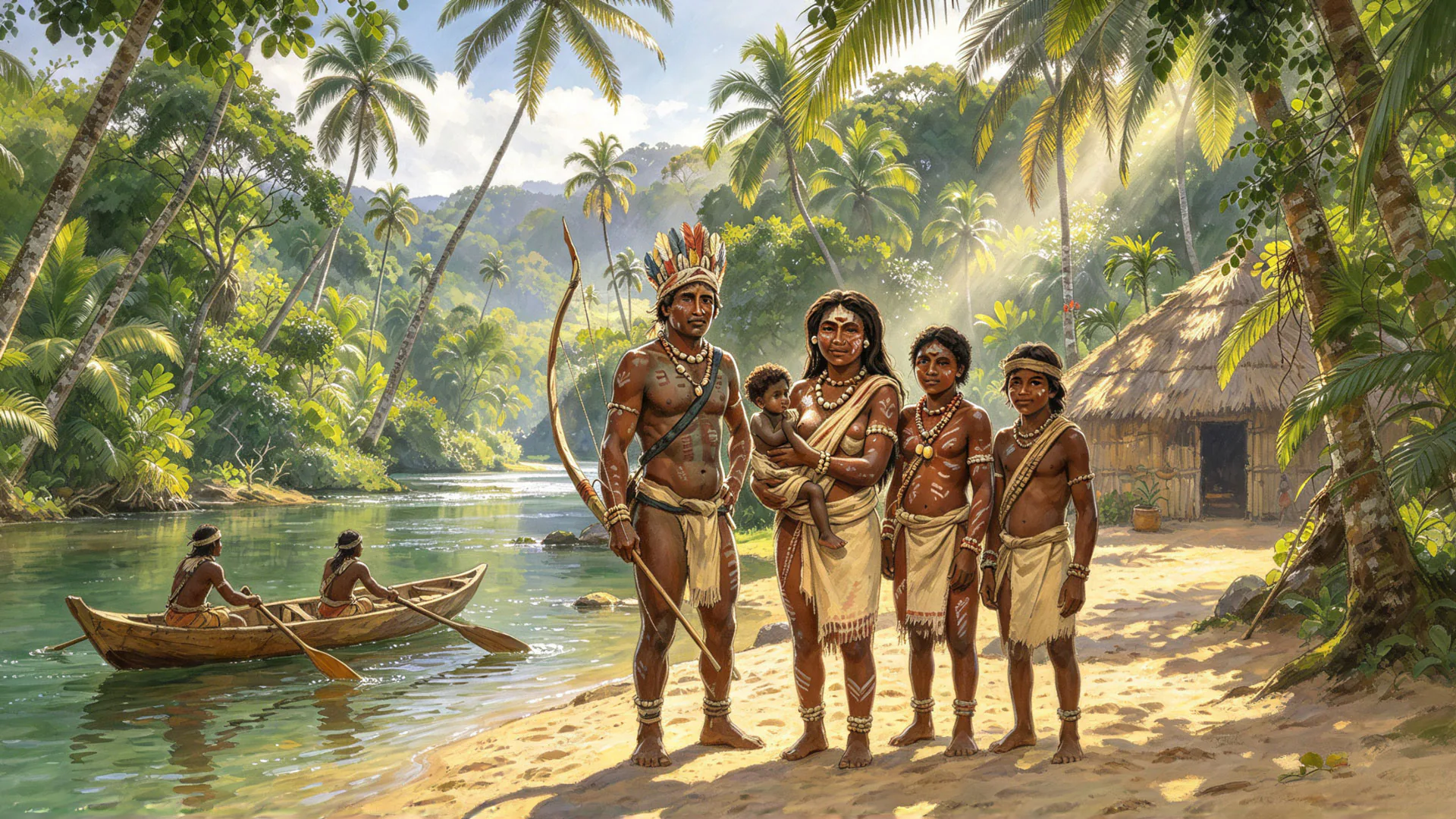
At the beginning of the 14th century, from the coast of Venezuela, travelling down the Orinoco river and skilfully handling their canoes, the warrior tribe of the Caribs settled in the Lesser Antilles, quite different in language from the Arawak peoples who already lived on the islands. From the point of view of the Taíno, their Arawak neighbours, the newcomers could hardly have been welcome: they differed in appearance and in customs, and most of all in their warlike nature and in a ritual that filled their neighbours with real fear – ritual cannibalism. Historians assume that, had it not been for the European conquest that destroyed all the Caribbean cultures alike, the Caribs would in time have come to dominate the whole island world, for at the moment of Columbus’s arrival they were in the full flood of conquest.
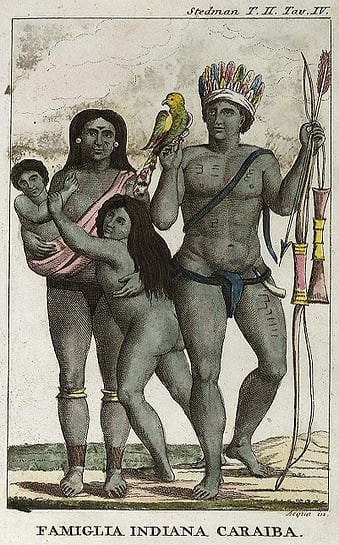
The name Caribs comes from the Arawak language and means roughly “man-eater” – a name given to them by their neighbours and then taken over by the European chroniclers (hence the very term cannibalism). It is important to stress that among the Caribs the ritual eating of human flesh did not serve as a source of food but was part of a complex of war and magic – it was believed that in this way the strength and courage of the defeated victim passed to the victor, and at the same time it served to terrify the enemy.
Carib society was also marked by a sharp division of roles between men and women. Polygyny was usual, and a man could bring the wives of defeated opponents into the community as well, while the men decided almost exclusively on war and other common undertakings. Captured enemy men usually became slaves or, in a smaller number of cases, victims of the ritual. Attacks were most often carried out at night: the Caribs would steal up to the Arawak settlements in their canoes and then, with shouting and the sound of trumpets, attack suddenly with burning arrows, killing the old and the grown men on the spot, while the women and children were taken into captivity.
On cannibalism
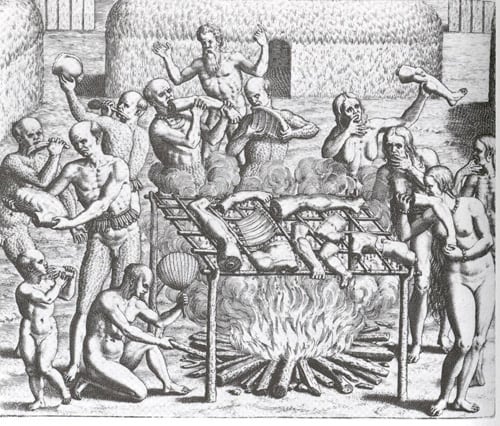
Cannibalism, or anthropophagy (from the Greek anthropos – man, and phagein – to eat), was by no means peculiar to the Caribs; ethnographic records note it, in different forms and with different meanings, among a number of peoples around the world, almost always in a religious and magical context. In some communities of New Guinea, ritual killing and the symbolic eating of the victim was part of lengthy fertility rites connected with the growing of the coconut palm. Among some South American peoples there is a recorded belief that eating the heart of a slain opponent passes his fearlessness on to the warrior – a motif very close to that of the Caribs. In certain Central African communities, by contrast, cannibalism lost its religious dimension and was practised as part of the everyday diet and a symbol of social prestige, while quite exceptional cases of cannibalism out of extreme necessity, in conditions of famine, are also recorded among individuals far removed from any cultural pattern.
Despite all these differences, ethnologists also recognize a common thread in these examples: ritual cannibalism, however cruel from today’s point of view, often strengthened the inner solidarity of the community and, by terrifying its opponents, increased its chances of survival in conflict with its neighbours. Among some other warrior peoples in history too – including the Māori of New Zealand, known for the ritual display of the heads of defeated enemies – a similar symbolic reckoning with the opponent was accompanied by special war songs and dances meant to mock and humiliate the defeated.