The Toltecs were a people whose capital, Tula, was the most important city of central Mexico between roughly 900 and 1150. We know about them from two very different sources: from the archaeological excavation of Tula and from the traditions of the Aztecs, who, centuries after the Toltecs had disappeared, celebrated them as their models and ancestors. The two pictures only partly match – which is why, in the story of the Toltecs, it is always important to distinguish what has been dug up from what has been told.
Tula, the place of reeds
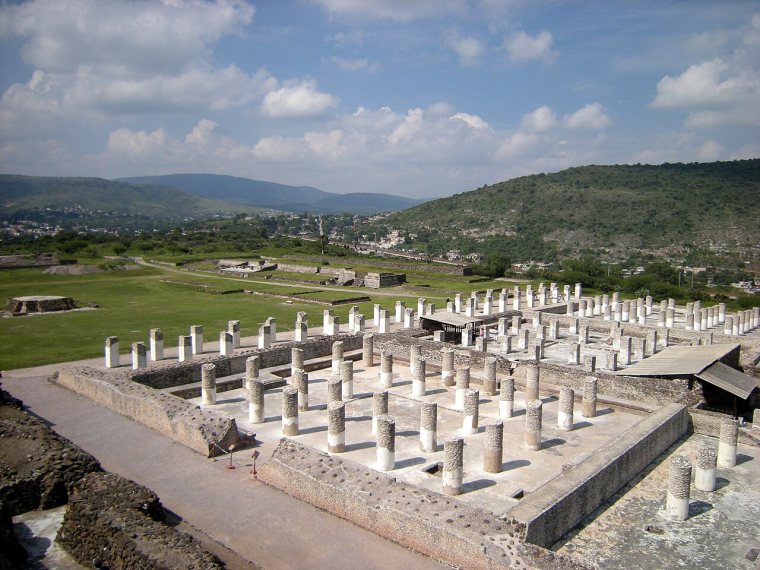
Aztec sources call the Toltec capital Tollan, which means “place of reeds” in Nahuatl; its full name, Tollan Xicocotitlan, means roughly “place of reeds by the hill of wasps”. The remains of the city lie near the present-day town of Tula de Allende in the Mexican state of Hidalgo, about 75 kilometres north of Mexico City, at an altitude of about 2,000 metres.
The city arose around 650, at a time when the great metropolis of Teotihuacan was already in decline, and it inherited many of its traditions. The first centre, which archaeologists now call Tula Chico (“Little Tula”), was burned and abandoned at the end of the 9th century, and a new ceremonial centre, Tula Grande, was built about a kilometre and a half further south. The city was at its height between roughly 900 and 1150. According to recent estimates, Tula then covered about 14 square kilometres and had up to 60,000 inhabitants, while older estimates speak of 30,000 to 40,000. It was probably the largest city in central Mexico in its day, though considerably smaller than earlier Teotihuacan and later Aztec Tenochtitlan.
The economy was based on irrigated farming and on crafts, above all the working of obsidian – the volcanic glass from which blades and tools were made. Tula was an important centre of the trade in greenish obsidian from the mines near Pachuca, and the city has also yielded obsidian from Ucareo in Michoacán, turquoise probably from the area of present-day New Mexico, polychrome pottery from Nicaragua or Costa Rica and the characteristic glossy plumbate ware from the Pacific coast of Guatemala and Chiapas, which is regarded as one of the hallmarks of a Toltec presence.
The Atlantean figures and Tula Grande
The heart of the city was the great plaza of Tula Grande, around which the main buildings were arranged: Pyramids B and C, the Burnt Palace (Palacio Quemado), two courts for the ritual ballgame and a low platform, the tzompantliA rack or platform on which the skulls of sacrificial victims were displayed. The one at Tula was excavated by the archaeologist Eduardo Matos Moctezuma in 1968–1970, when remains of human skulls were also found in it.. The largest of the pyramids, Pyramid C, is in poor condition today, so Tula’s best-known building is the smaller Pyramid B, dedicated to the god TlahuizcalpantecuhtliThe god of the morning star, the planet Venus when it appears before dawn. In the legends he is linked to Quetzalcoatl., lord of the morning star.
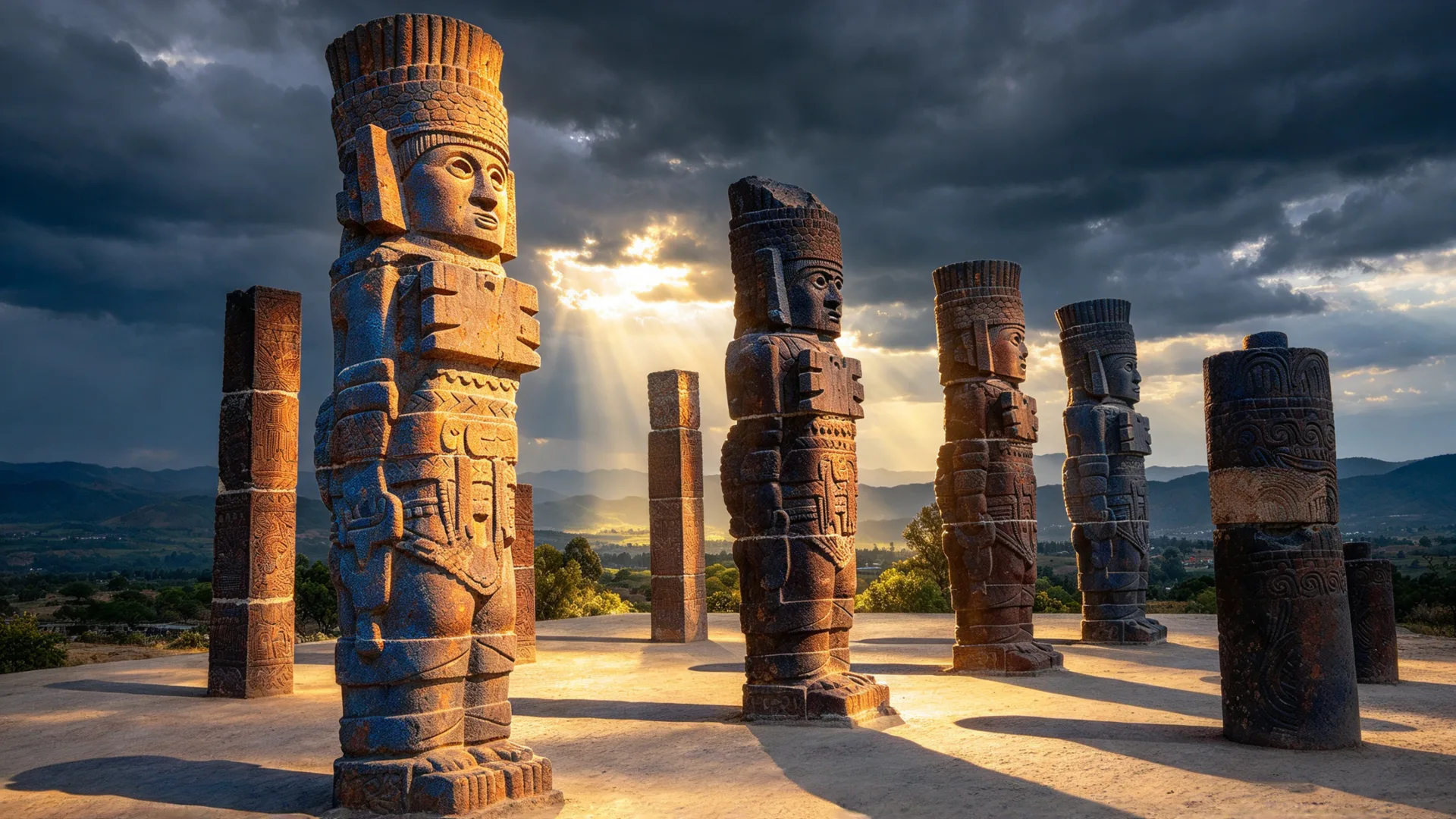
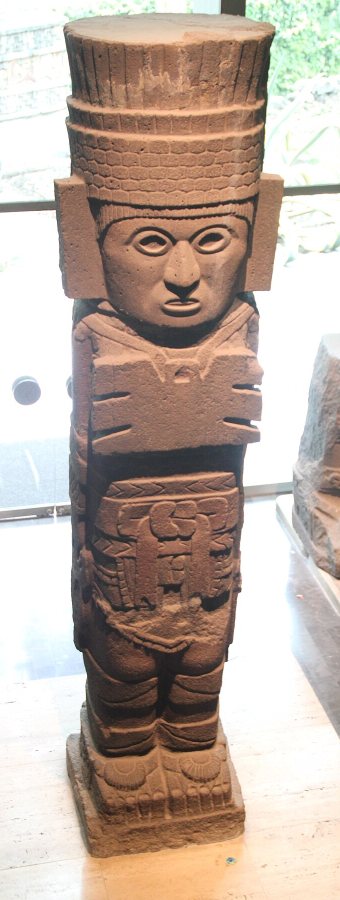
On top of Pyramid B today stand the famous Atlantean figures of Tula – four basalt columns in the shape of warriors, about four and a half metres tall, which once supported the roof of the temple. Each is made of four sections joined by tenon and socket, and the warriors wear a feathered headdress, a butterfly-shaped breastplate, a disc on the back and hold an atlatlA spear-thrower: a wooden handle with a hook at the end, which lengthens the arm and gives the dart much greater speed and range. in the hand. In front of the pyramid lay a vestibule with rows of columns, and the walls of the pyramid itself were covered with reliefs of jaguars and coyotes in procession and of eagles and vultures devouring human hearts.
The Atlantean figures were not found in place. In 1941, in the second season of excavation, the archaeologist Jorge R. Acosta came upon their scattered pieces in a test trench on the north side of the pyramid: three figures could be reassembled completely, while only part of the fourth was found. The pieces were first set up temporarily on the plaza and were returned to the top of the pyramid in 1960, when Acosta’s twenty years of research at Tula came to an end.
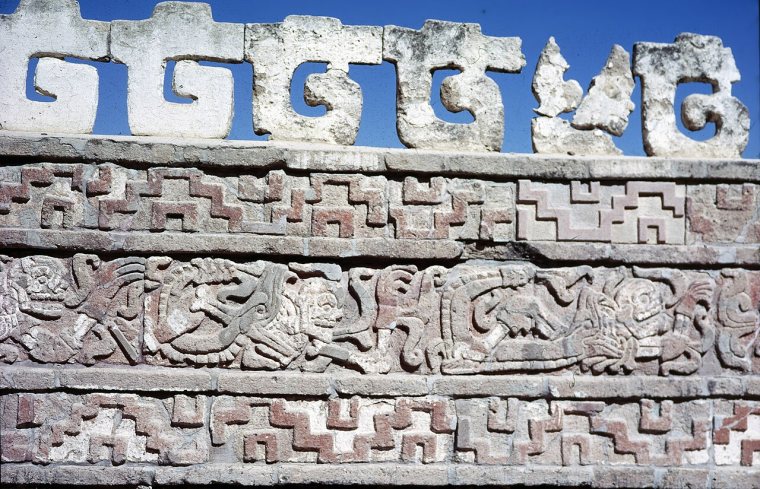
The north side of Pyramid B is closed off by the Coatepantli, the “serpent wall”, decorated with reliefs of snakes devouring human skeletons. Next to the pyramid stands the Burnt Palace, named after the traces of fire: its halls with columns had benches decorated with reliefs of processions of warriors and dignitaries, and sculptures of the chacmoolA reclining figure propped on its elbows, with its head turned to one side and a bowl or slab on its stomach, probably for offerings. Such sculptures appear both at Tula and at Chichén Itzá, and later among the Aztecs. type were found in them. During work in the 1990s, ritual caches with pyrite discs were discovered under the floor of one of the halls, some of them decorated with turquoise mosaic, and in the same period the so-called Tula cuirass, made of shell plaques, was also found.
Quetzalcoatl, Tezcatlipoca and the fall of Tula
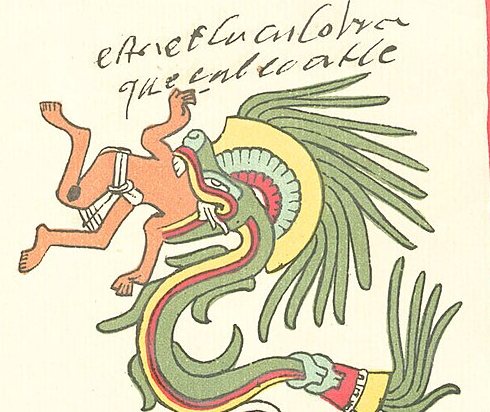
What we know about the rulers of Tula comes almost entirely from Aztec and colonial records written centuries later, such as the Florentine Codex of Fray Bernardino de Sahagún and the Annals of Cuauhtitlan. According to these traditions, the father of the first great ruler was the Chichimec leader Mixcoatl, and his son, Ce Acatl Topiltzin Quetzalcoatl – named after the year of his birth, “1 Reed”, and after the god the Feathered Serpent – became priest and ruler of Tula, remembered as a wise and pious king under whom the crafts flourished.
The best-known story tells of his conflict with Tezcatlipoca, the dark sorcerer god. According to tradition, Tezcatlipoca tricked Quetzalcoatl into getting drunk on pulqueAn alcoholic drink made from the fermented sap of the agave, which in Mesoamerica was drunk under strict rules and in rituals. and breaking his priestly vow; the shamed ruler left Tula and went east, towards the sea coast. In one version, recorded in the Annals of Cuauhtitlan, he burned himself there, and his heart rose into the sky and became the morning star – which links him to the god to whom Pyramid B is dedicated. In another, he sailed away on a raft of serpents, promising to return one day.
The traditions name Huemac as the last ruler of Tula, under whose rule the city was struck by famine, internal strife and the advance of Chichimec peoples from the north; the Toltecs, according to these stories, scattered in all directions, and Huemac himself fled to Chapultepec. The dates the sources give for these events differ from one another by almost a whole century, and many researchers believe that history and myth are inseparably mixed in these stories.
Archaeology confirms that the end was violent: sometime between 1150 and 1200 most of the city was burned and abandoned, the monumental buildings were looted, and many sculptures were smashed and buried in the mounds of the pyramids – among them the Atlantean figures. Yet Tula was never completely deserted; it was later resettled by people of Aztec culture, who dug through the ruins in search of sculptures and buried offerings.
The Toltecs in the eyes of the Aztecs
For the Aztecs, who founded their capital Tenochtitlan almost two centuries after the fall of Tula, the Toltecs were the embodiment of civilization. The Nahuatl word toltecatl meant “artist, skilled craftsman”, and toltecayotl – “Toltec-ness” – meant art, learning and city life in general, as opposed to the “Chichimec” way of life of the nomads of the north. They credited the Toltecs with the invention of the calendar, medicine and many crafts.
Toltec descent was also a source of political legitimacy. The first Aztec ruler, Acamapichtli, was chosen, according to tradition, precisely because on his mother’s side he came from the noble line of Culhuacan, a city regarded as the heir of the Toltecs, and the rulers of other Mesoamerican cities claimed similar descent. That is why researchers today warn that the picture of the Toltecs as a great empire probably says more about Aztec needs than about the real Tula, whose influence, by some estimates, was more modest – closer to a kingdom than to an empire.
Tula and Chichén Itzá
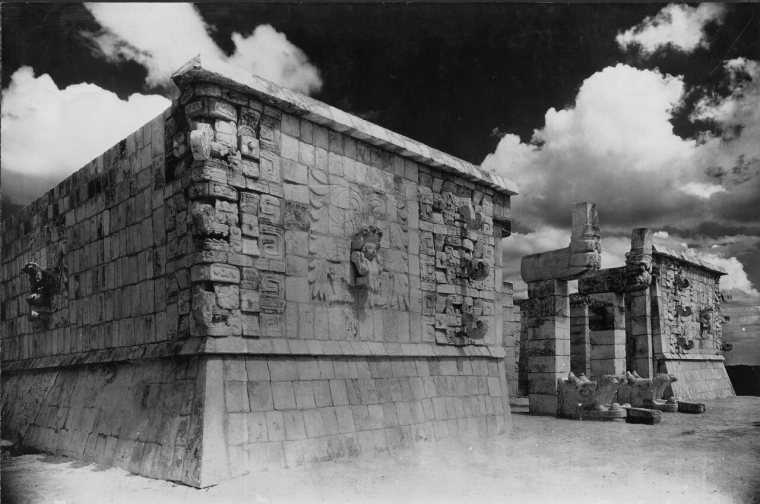
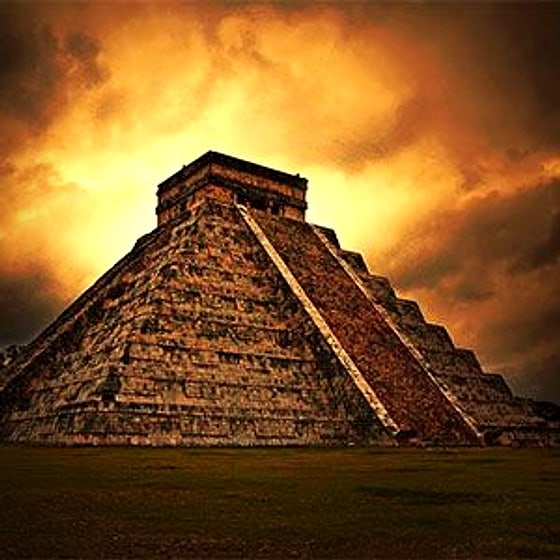
When the French explorer Désiré Charnay first dug at Tula in the 1880s, he was astonished by its resemblance to the Maya city of Chichén Itzá in Yucatán, more than a thousand kilometres away: there too are columns in the shape of warriors and feathered serpents, processions of jaguars and eagles, chacmools and a skull rack. Charnay concluded that the Toltecs had conquered Chichén Itzá, and the idea was supported by the Maya tradition of Kukulcan – the “Feathered Serpent” – who came from the west.
Present-day scholarship is much more cautious. Some researchers still see in Chichén Itzá a trace of a Toltec presence, others believe both cities were part of a wider network of trade and a shared cult of the Feathered Serpent, and newer dating shows that some buildings in the “Toltec” style at Chichén Itzá are older than the height of Tula, so the influence may also have run the other way. For now there is no unanimous answer.
Between history and myth
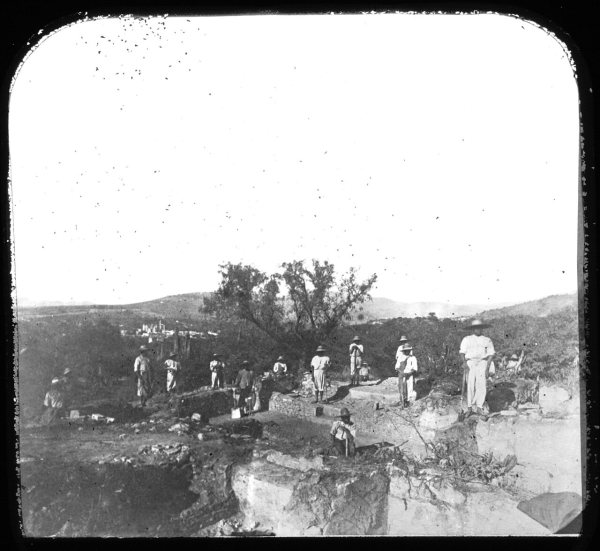
The ruins near Tula were described as early as 1873 by the Mexican geographer Antonio García Cubas, and the first excavations were carried out by Charnay. Even so, it was long believed that the Tollan of the Aztec stories was in fact Teotihuacan. The turning point came in 1941, when the historian Wigberto Jiménez Moreno, at a round table of the Mexican Society of Anthropology, showed on the basis of historical sources that Tollan was indeed Tula in Hidalgo – in the same year in which Acosta found the Atlantean figures. Acosta worked at Tula until 1960, and the research was then continued by Eduardo Matos Moctezuma, Alba Guadalupe Mastache, Robert H. Cobean and others.
Even today historians disagree about how far the Aztec stories of the Toltecs can be trusted. Some, such as Nigel Davies and H. B. Nicholson, believed that with careful comparison a historical core could be drawn out of them; others, such as Susan Gillespie and Michel Graulich, see in them above all a mythical picture of the past that the Aztecs shaped to their own needs. What is beyond doubt is Tula itself – a great city whose builders, stone warriors and cult of the Feathered Serpent left a deep mark on the art and beliefs of Mesoamerica right up to the arrival of the Spaniards.