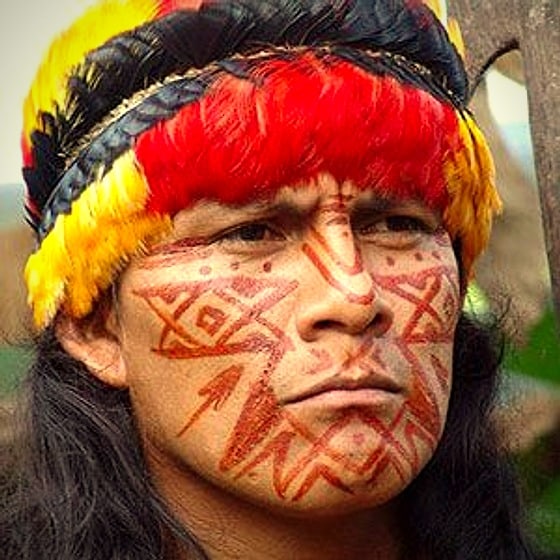
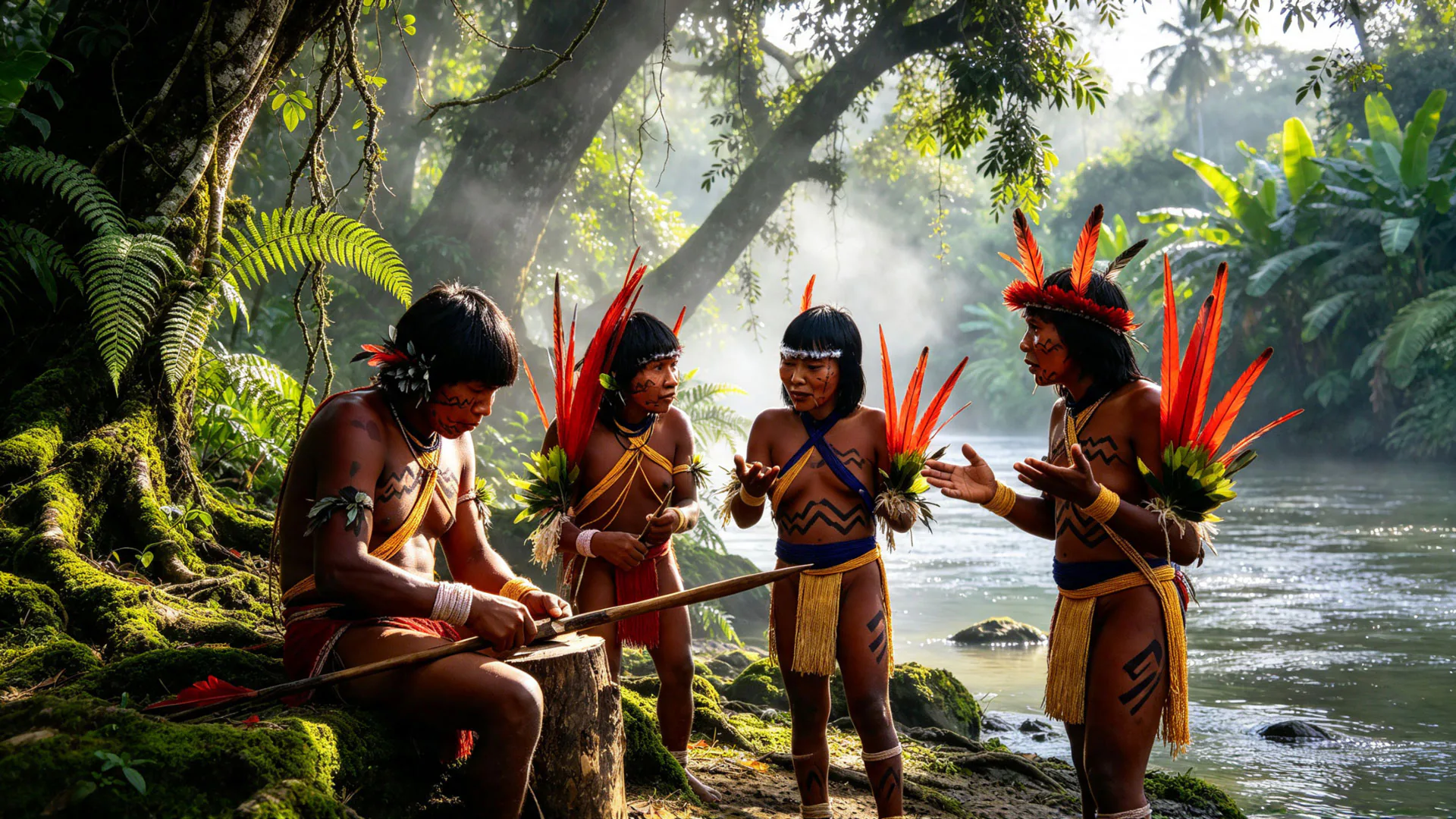
The Yanomami, a people who call themselves simply “people”, live in the dense rainforests of the upper Orinoco and the northern Amazon, on the border of Venezuela and Brazil. They are one of the largest indigenous communities of South America and remained almost completely isolated from the outside world until the middle of the 20th century, spread across more than two hundred small settlements scattered through the rainforest.
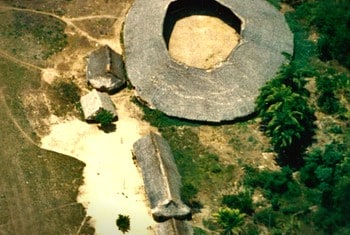
The basic unit of housing and society is the shabono – a huge circular structure of poles and palm leaves, open towards an inner courtyard, under whose roof the whole village lives, sometimes several hundred people. Each family has its own hearth along the outer edge of the ring, while the middle is left free for gatherings and rites. The Yanomami practise slash-and-burn farming, growing mainly bananas and cassava, and supplement their diet by hunting with bow and arrow and gathering forest fruits.
Yopo and the hekura spirits
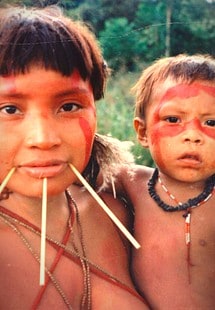
Religious life is closely bound up with shamanism. The shamans, called shapori, commune in a trance with the hekuraSpirits of nature in Yanomami belief, whom the shaman summons in a trance to protect the village from illness and evil influences. spirits by inhaling yopoA hallucinogenic powder prepared from the bark or seeds of a forest tree, which an assistant blows into the shaman’s nose through a long hollow tube during the rite., a powder that an assistant blows into their nose through a long hollow tube. Shamanic rites accompany almost every important moment in the life of the community, from healing the sick to preparing for war or peace with neighbouring villages.
The death of a member of the community is followed by a special rite of remembrance, the reahuA ritual feast of the Yanomami; in its mourning form, the ashes and crushed bones of the deceased are mixed into a banana mash that is drunk by relatives and friends.: the body of the deceased is cremated, and the ashes and crushed bones are mixed into a banana mash that relatives and friends drink during the feast. In this way, according to Yanomami belief, the vital essence of the dead person stays within the community instead of vanishing for ever into the ground.
For a long time the Western world knew very little about the Yanomami. Only from the 1950s, with the arrival of missionaries and then of anthropologists – among them Napoleon Chagnon, whose fieldwork in the 1960s shaped the earlier image of them as “the fierce people” – a description later challenged as oversimplified, since warfare between kin groups was only one, and a rare, part of a far more complex social life. A more serious disruption followed in the 1980s, when gold prospectors pushed deep into their territory, bringing diseases to which the Yanomami had no resistance. The international pressure that followed led Brazil in 1992 to declare officially the protected Yanomami territory, one of the largest indigenous reserves in the whole of Amazonia.