The kingdom of Chimú (or Chimor) developed on the northern coast of Peru from about the 13th to the 15th century AD, over a territory of some 40,000 square kilometres – from the valley of the Moche river in the north to the Zarumilla and Chancay rivers in the south. Towards the end of its existence it fell under the rule of the Inca, in the reign of Pachacuti, and in the second half of the 15th century it was annexed to the empire of Tawantinsuyu. Most of what we know today about the origin and downfall of this state comes from the writings of the Spanish conquerors, who collected the traditions and myths about it from the local population.
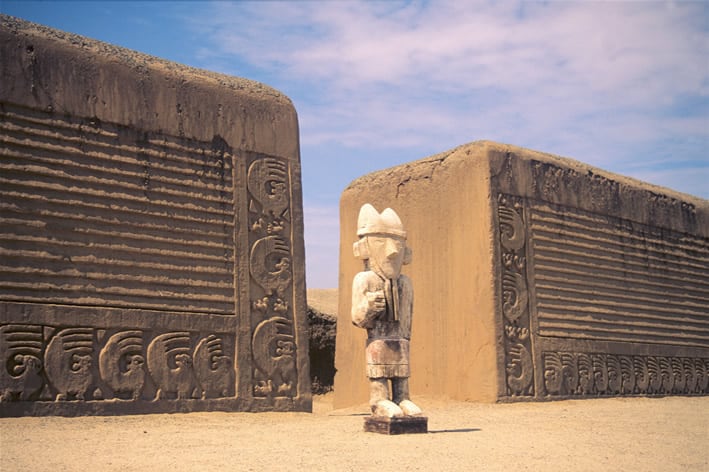
According to the 17th-century Spanish priest and chronicler Antonio de la Calancha, the central place in the religion of the Chimú was held by the Moon, revered more than the Sun precisely because, unlike the Sun, it is visible both by day and by night. The Moon was believed to govern nature – the growth of plants, the tides, the coming of dawn and of thunder – and its eclipses were celebrated as moments of its victory in the eternal cosmic struggle; if on some night it did not appear in the sky, this was taken to mean that it was busy punishing sinners in the world beyond.
Since the Chimú, like the neighbouring and older Moche culture, from which they also inherited their irrigation system, were a people of the coast, it is assumed that they inherited the cult of the Moon from the Moche as well – whereas the cultures of the Andean interior, such as Tiwanaku, were more devoted to the cult of the Sun. Besides the Moon, the Chimú also revered the sea (Ni), the source of life to which offerings were made, as well as certain stars and the cult of the ruler himself; the most widespread religious symbol was the serpent, associated with fertility throughout the American continent. The dead, especially rulers, were buried with rich grave goods – food, weapons, objects, and sometimes with one of their wives, children and pets.
The Chimú were outstanding goldsmiths, and their characteristic black, mould-made pottery is still highly prized today. The economy rested on a developed irrigation system, inherited from the Moche, which watered crops of peppers, squash, beans, maize, peanuts, sweet potato and cassava, along with various fruits. They fished, again by a technique taken from the Moche, from rafts (with nets) and boats (with hooks), and depictions on their pottery bear witness to another unusual skill – training cormorants to catch fish for them.
Chan Chan, the city of mud
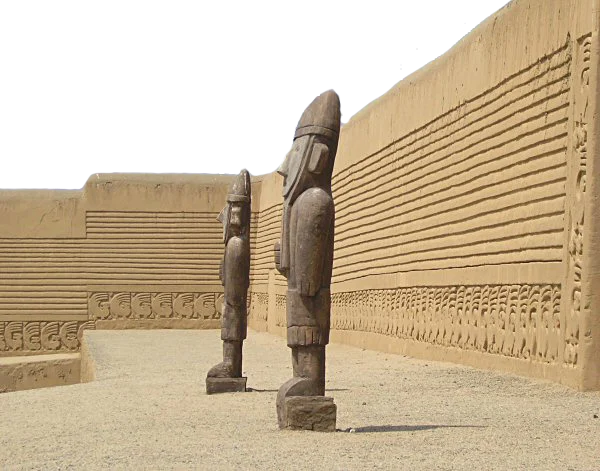
The Chimú descend from several smaller communities that lived in the area around Chan Chan and which, once united, grew into a powerful state of the central Andes. The founding of the royal dynasty is told in the tradition of the semi-mythical hero Taycanamo – similar to Manco Cápac among the Inca – who is said to have arrived in the Moche valley on a raft, as the envoy of a mighty lord from across the sea, bringing with him a magic golden powder. He built a palace, and around 1300 the local people made him their chief.
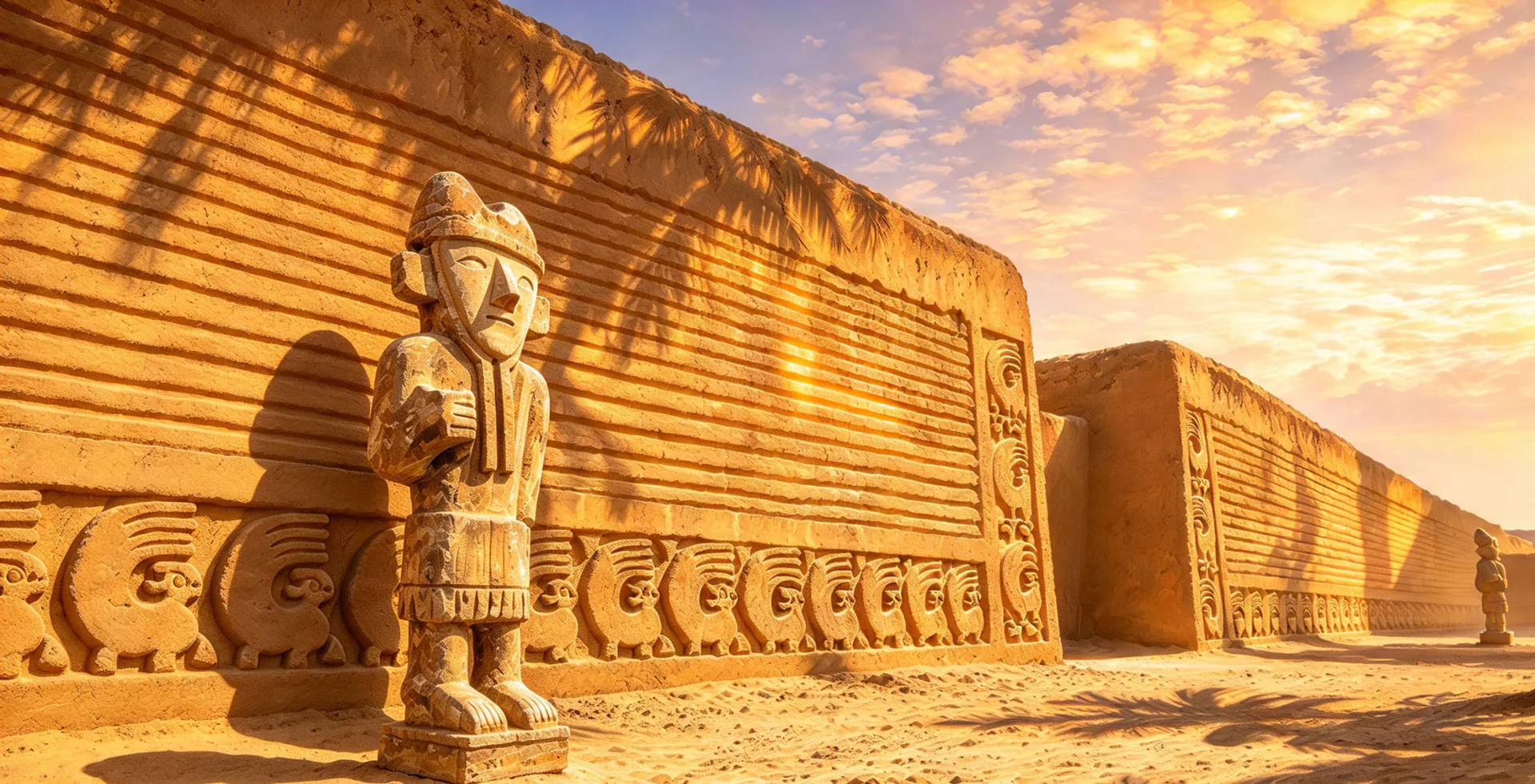
Archaeological finds show that a settlement existed on the site of Chan Chan from about 800, but the city reached its full splendour only with the coming of Taycanamo and his dynasty, which, including him, numbered ten rulers. The kingdom reached the height of its power in the mid-15th century, under the last of them, Minchançaman, when it stretched along the Pacific coast for about 960 kilometres, and Chan Chan itself – with an area of about 20 square kilometres and close to 40,000 inhabitants – was even larger than Cusco.
At the very heart of the city stood ten large walled compounds; it is assumed that each of the ten rulers of the dynasty built his own, adding it to the compound of his predecessor. In life these spaces served as royal palaces, and after the ruler’s death they were turned into his shrine, while his successor built a new compound for himself. In one of the mounds archaeologists found the remains of a hundred young women, who are assumed to have been sacrificed at the burial of a ruler.
The end came with the advance of the Inca: Minchançaman put up little resistance, and Chimú was defeated and joined to an empire in unstoppable expansion. In keeping with the usual Inca practice towards conquered peoples, the new masters acted relatively mildly – as governor of the defeated kingdom they installed Chumun Caur, son of the last Chimú ruler. Yet between 1485 and 1490 the unity of the former kingdom was completely broken, and the Inca simply took over for themselves the many achievements of Chimú culture, from craft skills to irrigation – only for the Inca empire itself to suffer the same defeat a few decades later, this time at the hands of the Spanish conquistadors. Chan Chan is still regarded as one of the largest cities of unfired brick ever built, and its remains bear witness to the former greatness of the kingdom of Chimú.