The Sun god Inti, seeing that people lived like animals, took pity on them and sent two of his children to bring them wisdom, to teach them various skills and to give them laws, so that they might leave savagery behind. Those children were the first Incas, Manco Cápac and Mama Ocllo.
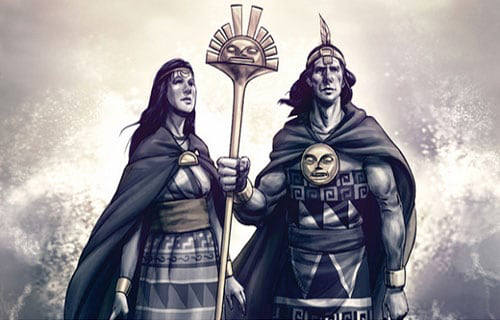
Inti set them down in the waters of Lake TiticacaThe largest lake in South America and the highest navigable lake in the world, at about 3,800 m above sea level, on the border of present-day Peru and Bolivia. In Andean tradition it was regarded as the place where the world began. and gave them a golden rod, telling them that wherever they went and stopped they should try to drive it into the ground. Where the rod sank in at a single blow, there they were to found a city and a royal court. The earth swallowed the golden rod on a hill (Huanacauri), and there Cusco was founded, the capital of the largest empire in pre-Columbian America.
This and several other Andean legends about the origin of Inca civilization differ from one another, but they share one and the same mytheme: that Manco Cápac and Mama Ocllo were the first Incas.
Tawantinsuyu
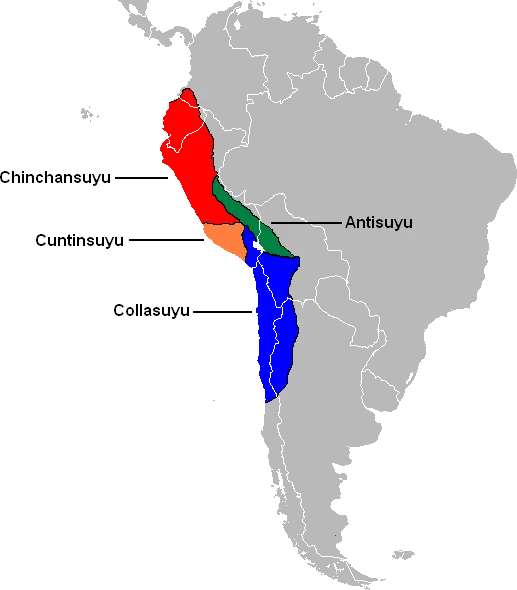
The Inca empire was called Tawantinsuyu, which means the realm of the four quarters of the world, and it consisted of four parts: Chinchaysuyu, Kuntisuyu, Antisuyu and Collasuyu. It stretched along the Pacific coast and the Andes for more than 4,000 km, from present-day Ecuador to Chile, and covered 950,000 square kilometres. Its capital was Cusco.
According to legend there were 13 Inca kings, but for lack of evidence the first eight are considered mythical; they were probably chieftains. The history of the Inca begins in the 15th century, in the reign of Pachacuti Inca Yupanqui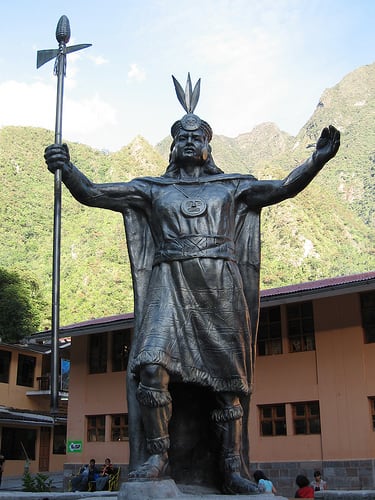 Pachacuti Inca Yupanqui Monument to Pachacuti Inca Yupanqui, Aguas Calientes, Machu Picchu. (1438–1471), and lasts about 100 years.
The empire was linked by a magnificent network of roads, on whose building and upkeep the Inca spent great resources. These roads were certainly one of the most effective tools for subjugating other peoples and expanding the empire. Four main roads set out from Cusco, linking all four parts of the empire. Along them stood rest houses and storehouses with food and military equipment (tambos), each within a day’s walk of the next.
Where the deep, wide canyons of great rivers had to be crossed, suspension bridges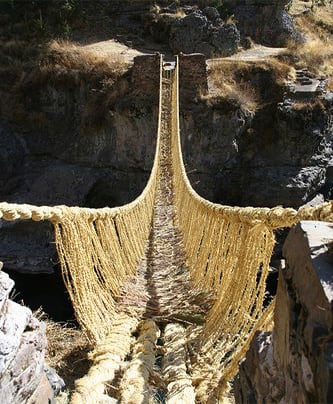 Suspension bridges Thick ropes twisted from plant fibres and reinforced with wooden rods laid crosswise, fastened on both sides of the canyon to solid stone structures or to the rock. Two horses could cross such a bridge at the same time with no danger of its collapsing. were built. Had it not been for these well-kept roads, the Inca would not have had their efficient network of messengers (chasquis
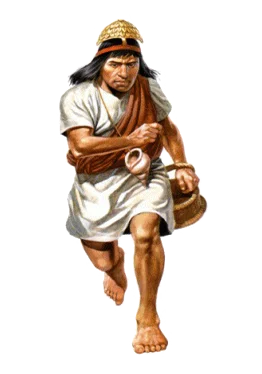 Chasqui messengers They were engaged only for state purposes or were in the service of the ruler. They carried reports on the state of resources recorded on quipus, or delivered messages by word of mouth. There were stations at short intervals along the roads, so that a tired messenger passed the message on to a fresh one, and so the chain ran on to its final destination.) by which messages were carried.
Cusco (between history and myth)
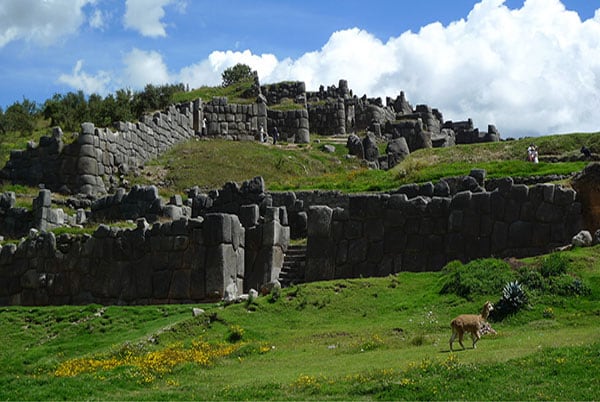
In Quechua (runa simi, the language of the people), which was also the official language of the empire, Cusco means “Navel of the World”. According to tradition it was founded by the first Inca, Manco Cápac, around the 12th century. It lies in the Andes at a height of about 3,500 metres. The city was divided into two parts, the upper (Hanan) and the lower (Hurin). Cusco represented the body of a puma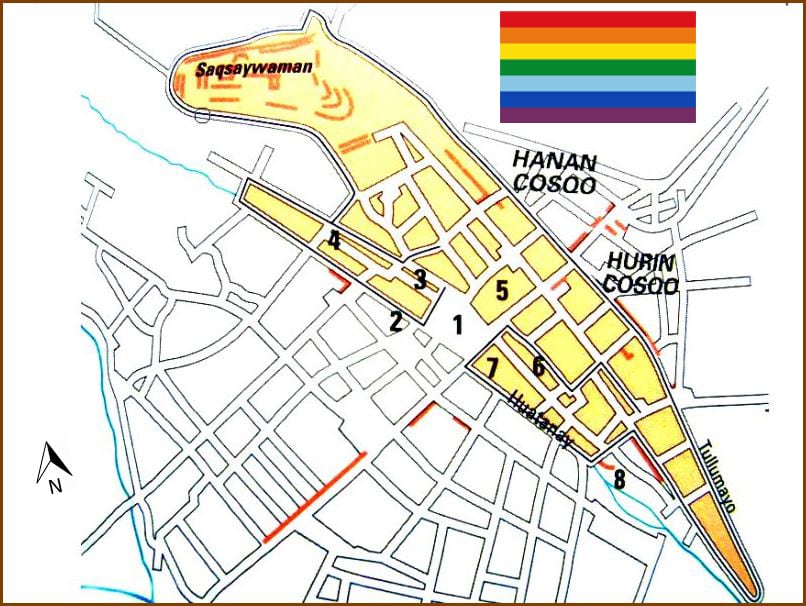 Cusco in the shape of a puma The plan of the city and the flag of Cusco (the colours of the rainbow)., while its head, with sharp teeth, was embodied in the fortress.
The expansion of the Inca empire begins with the defence of Cusco and the subjugation of the Chanka people. Official history tells us that this happened in the reign of Pachacuti Inca Yupanqui (1438–1471). Garcilaso de la Vega, El Inca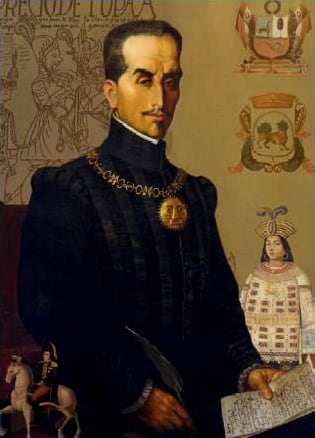 Garcilaso de la Vega, El Inca (1539–1616) was the son of a Spanish conquistador and an Inca princess. He wrote on the basis of the stories told to him by his relatives on his mother’s side (the Inca nobility). He published the first part of the “Royal Commentaries” in 1609; the second part appeared posthumously in 1617. The Inquisition and the Spanish authorities destroyed and banned his books, and only in the 18th century could they be read again. disagrees. In his famous book “Royal Commentaries of the Incas” he says that the Spanish chroniclers confused Pachacuti Inca Yupanqui with his father, Inca Viracocha.
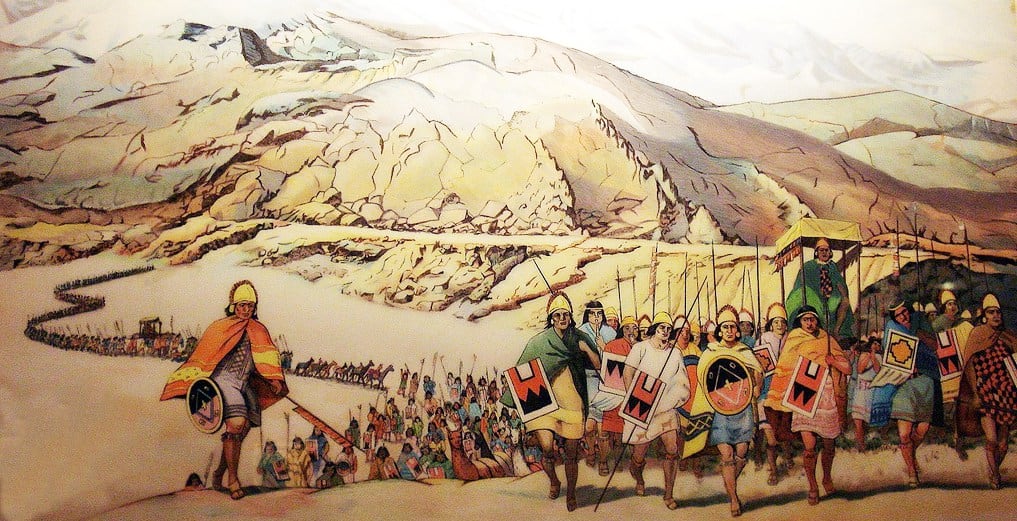
Inca Viracocha had a premonition from the god Viracocha himself, who told him in a dream that the Chanka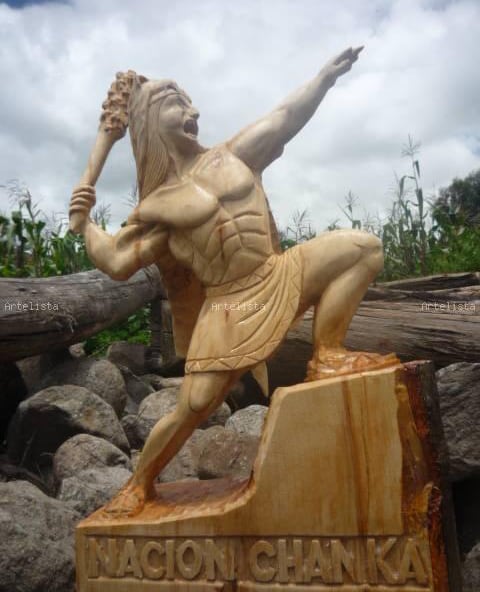 The Chanka Monument to the Chanka people. were preparing to overthrow Cusco and the rule of the Inca, that they would come with a great army and that a defence must be prepared, and that Inti (the Sun) would help them in this. Three months after that dream, the province of Chinchaysuyu, where the Chanka lived, rose against the Inca and a great campaign against Cusco was being prepared. That army numbered over 30,000 warriors, led by the brave commander Hanco Huallu.
As the mighty army pressed on towards Cusco, panic broke out and a large part of the city fled, together with its king, Yahuar Huacac. In that chaos the prince, Inca Viracocha, gathered the scattered soldiers (about 12,000 of them) and everyone who could bear arms, and called on them to return and defend the city with him. While he was assembling his scattered army, he sent messengers to the Chanka to tell them that he would forgive their rebellion if they returned to their homes. Hanco Huallu sent back his answer: “Tomorrow it will be seen who is king and who may forgive whom.”
To the sound of horns and shells, the Inca army, though smaller in number, withstood the attack of the Chanka warriors. After several hours of bloody fighting the Chanka began to give way, because new and fresh forces were reaching the Inca from other provinces, as were those scattered soldiers whom the prince had not at first been able to gather. The Inca warriors cried out that the premonition Inca Viracocha had had was coming true and that the Sun god Inti had begun to turn stones into warriors. The superstitious Chanka, who at that moment were losing a battle they had almost won, surrendered after eight hours of fighting. About 8,000 Inca warriors fell, while the Chanka lost over 20,000.
Religion
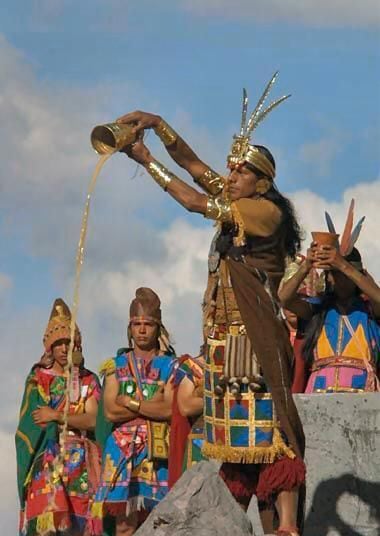
As the empire expanded, the Inca imposed political and economic domination on the conquered tribes and peoples, but in most cases they respected their traditions and religious spirit. Although they imposed their state religion of Sun worship, all conquered peoples were free to keep up their own beliefs and retain their own deities, which were most often a form of nature worship.
The Andean peoples believed that the world had arisen from stone as the primordial element, into which the mighty deity Apu Kon Tiki Viracocha breathed spirit and gave life. Viracocha was regarded as the creator of all that exists. Garcilaso de la Vega says that Viracocha was not the supreme deity and that the Spanish chroniclers misunderstood this through ignorance of the language, and that he was in fact a son of the Sun god, Inti. Nor does he agree with the Spanish chroniclers that the Inca offered human sacrifices; on the contrary, he says that they forbade such rituals.
The most prominent place in the Inca religion belonged to the Sun god, Inti. In his honour the Inca raised many temples and dedicated ceremonies to him. In Cusco stood the magnificent temple of CoricanchaThe “Golden Enclosure”, the most important temple of the empire, dedicated to Inti. The Spanish plundered it and built the church and convent of Santo Domingo on its foundations; they still stand on Inca walls today. (the Golden Enclosure), whose inner walls were covered with gold. One of the main festivals dedicated to Inti was Inti Raymi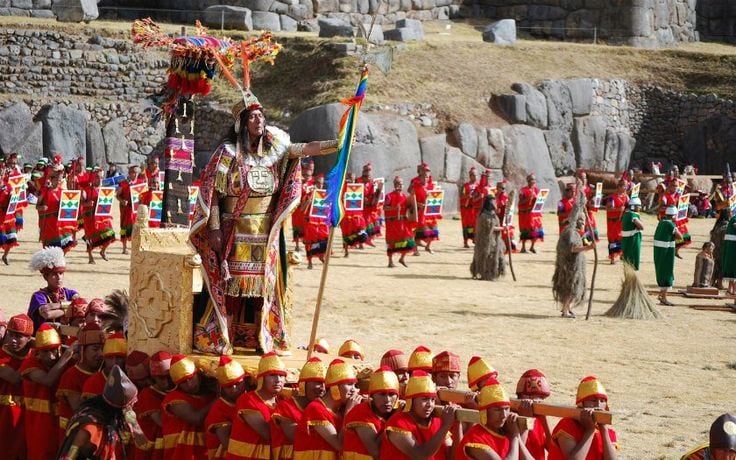 Inti Raymi The Festival of the Sun, the Inca new year, which is still celebrated in Cusco today., the Inca new year, which is celebrated to this day.
The world was divided into three vertical spiritual levels:
- Hanan Pacha – the vault of heaven
- Pacha Mama – the earthly world
- Uku Pacha – the underworld, where the dead dwell
All three worlds were inhabited by spirits called huacasA huaca is anything that is sacred: a mountain, a spring, a rock, a temple or an ancestor. Huacas were honoured with offerings and rites in every corner of the empire.. The huacas were the foundation of the folk religion, which merged with the state religion of the solar cult.
Social order and laws
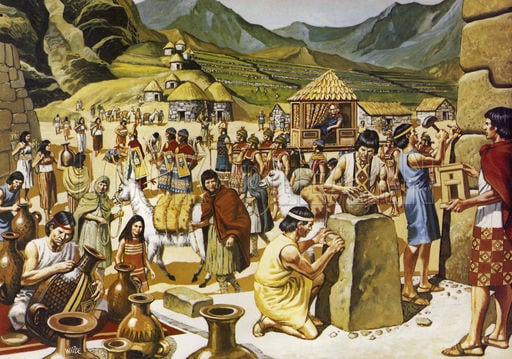
The basis of the social system was the ayllu, a kind of kinship community. The members of an ayllu shared a common territory and received a certain portion of land called a suyu. Part of the yield of that land went to the emperor as a tax for the needs of the state and religion, while the rest remained with the community, which shared it out among its members. This, then, was a kind of taxed economy of solidarity. The ayllu had its representative, a chief called the curaca, who organized it and answered to the emperor on its behalf.
Refined and complex works for adapting the terrain are evidence of their power to reshape and change nature (for example the famous terraces used as farmland). In the ayllu neither polygamy nor incest was permitted. Only the imperial family could have that privilege, in order to preserve the purity of the blood. Besides their usual activities, the state also demanded of the members of the ayllu the mit’aCompulsory unpaid labour for the state, done in turns. This is how the roads, bridges, terraces and temples of the empire were built. The Spanish later turned the mit’a into forced labour in the silver mines., that is, the duty of unpaid work for the benefit of the state. This duty applied to men between 25 and 50 and covered the building and upkeep of roads, temples, palaces and so on.
Education was acquired in the houses of knowledge (Yachaywasi), which were attended only by men of noble birth. Schooling lasted four years. They learned the language, religion, the reading of quipus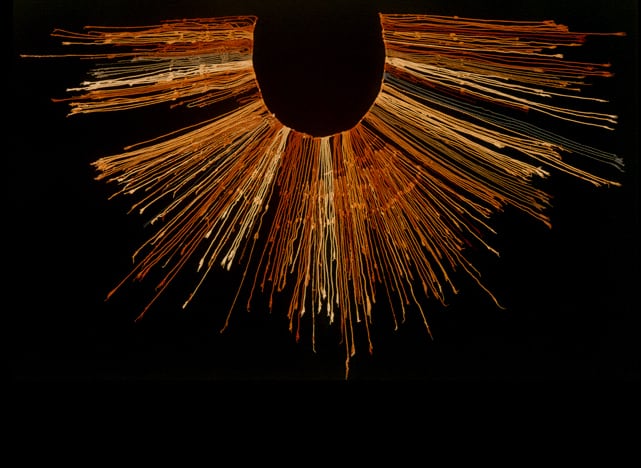 Quipu A system of knots tied on cords that made it possible to pass on messages. With the knots they made calculations in units, tens and hundreds, and with colours they indicated resources and people. The system was deciphered in 1912 by Leslie Leland Locke., the history of the empire, the art of government and the art of war. If pupils were disobedient, the teacher (amauta) could beat them on the soles of their feet, and if a teacher mistreated his pupils, his right hand was cut off.
The laws of the Inca were very strict and were obeyed. There were no privileges and no one was above the law, not even the nobles. Theft, disobedience, murder, adultery, abortion, prostitution and so on were forbidden in the empire and severely punished. Serious offenders ended up in the prison of Sankay Huasi, a building made of pointed stone, sharp as a knife, and full of bloodthirsty and venomous animals. If an offender happened to survive the attacks of the animals, the ruler would grant him his freedom and restore all his privileges, if he was a noble. Watch this story as a short video
The fall of the empire (the events at Cajamarca)
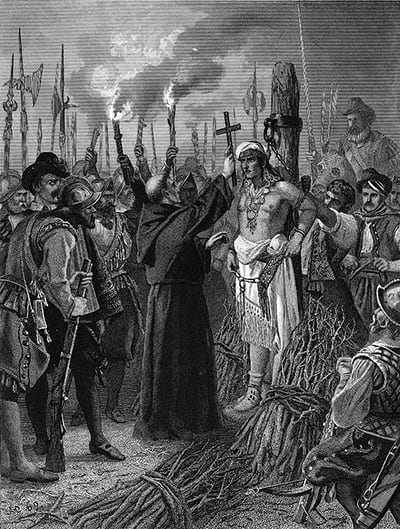
At the end of the civil war that broke out between two kings, Huáscar and Atahualpa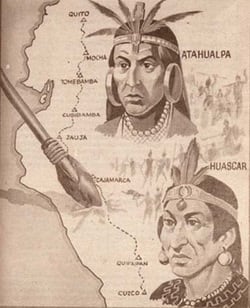 Huáscar and Atahualpa Brothers and rivals in the civil war that weakened the empire just before the arrival of the Spanish., Atahualpa came to power by his victory in 1532. In the same year the Spanish entered Inca territory and were the first Europeans to set foot in the Andes. The people who saw bearded men on large, strange animals believed that the god Viracocha had come. The news spread quickly through the empire, and Atahualpa sent gifts to the Spaniards and an invitation to come to Cajamarca, the place where he was encamped with his 80,000 warriors.
Francisco Pizarro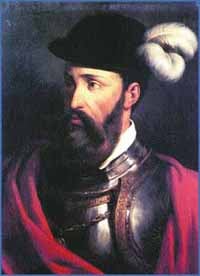 Francisco Pizarro (1478–1541). Born in the small Spanish town of Trujillo. In his youth he worked as a swineherd, and later became a conquistador. He left Spain and lived for a time in what is now Panama, from where he set out in search of El Dorado., the leader of the expedition, who had left Central America with 168 well-armed men, accepted Atahualpa’s invitation. On 15 November 1532 he arrived in Cajamarca, where he and his conquistadors took up quarters in the very centre of the town and prepared for the next day’s meeting with the emperor. That night none of the conquistadors slept, and some of them even wet themselves uncontrollably out of fear.
When that agonizing night had passed for the Spaniards, everything was ready for the trap in which the emperor was to be captured. Atahualpa set out to meet Pizarro with his retinue of 5,000–6,000 unarmed men. When he reached the square, no one was there. He probably thought that these strange people had taken fright and already fled, and then at a certain moment Valverde (Vicente de Valverde) came out. He was a Spanish priest who addressed the emperor in an incomprehensible language, telling him that he and his subjects should convert to Christianity, and then gave him a Bible, which Atahualpa turned over in his hands in wonder and threw to the ground.
That was the pretext, or rather the signal, for the attack to begin. With the fire of their weapons, which the Inca had never seen, the Spaniards spread fear and panic among the unarmed men. In that chaos they were an easy target for the cavalry, which cut them down with ease. Several thousand people were killed, and Pizarro himself captured Atahualpa.
The imperial quarters in Cajamarca were turned into a prison for Atahualpa, who was kept as a hostage and a guarantee that the Inca would not attack. He was promised that he would not be killed if he handed over gold. Atahualpa raised his hand high and said that he would fill the room with gold up to that point. Gold from all over the empire was melted down to pay the ransom; some 20 tonnes of gold and silver were melted. The artistic value of the gold objects, now turned into ingots, was destroyed for ever. Once he had the gold, Pizarro did not keep his promise and had Atahualpa executed on 29 August 1533. The Inca empire fell apart and the Spanish became the new masters of the Andes.
Although at first sight it seems that the Inca empire fell so quickly because it had been decimated by disease and civil war, and because the conquistadors had guns and horses, all that was not enough to destroy the Inca empire in a single day. The most powerful weapon the Spanish had was strategy and cunning, or more precisely the capture of the emperor. Pizarro knew that strategy very well, having learned it from his predecessor Hernán Cortés, who had conquered the Aztec empire in a similar way. The Inca empire was destroyed by one single book, entitled “A Handbook for Future Conquistadors – Hernán Cortés”.
Machu Picchu
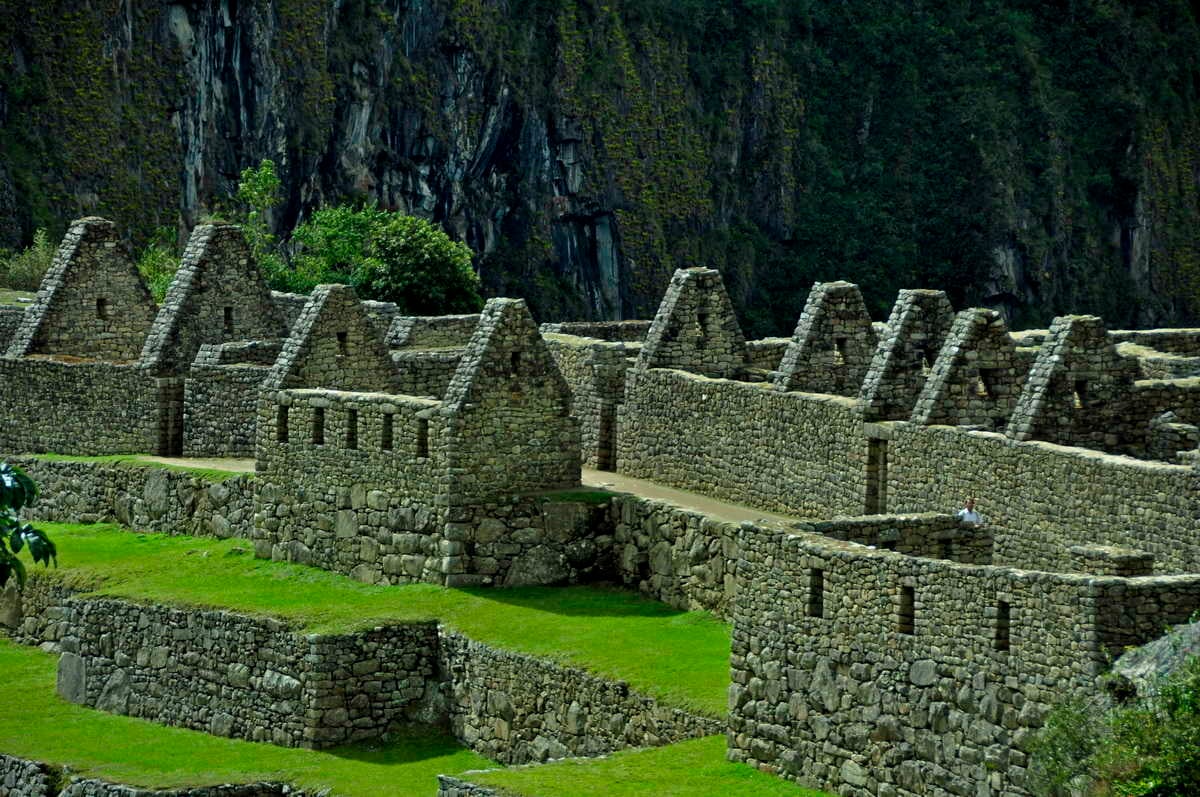
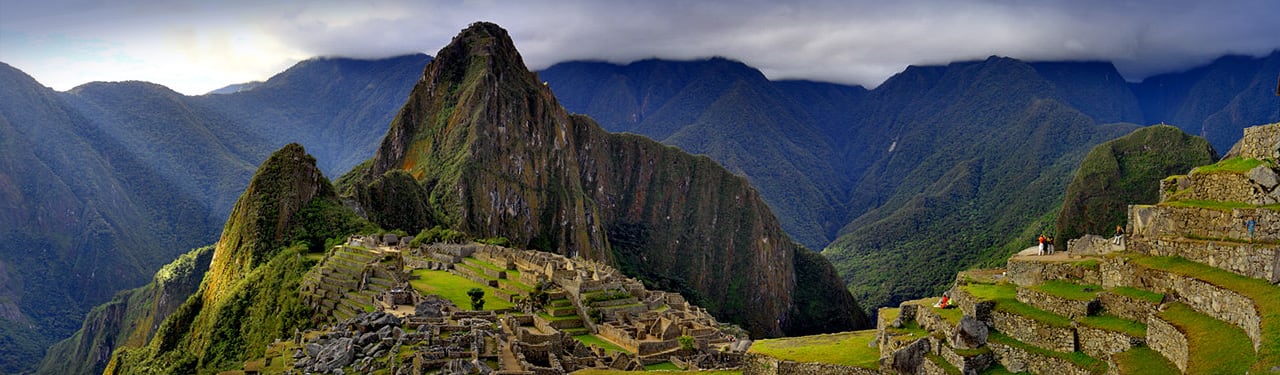
After the fall of the empire, the last Inca emperor withdrew to a mountain city called Vilcabamba. That city was the last remnant of the great empire and lasted about 35 years, until the Spanish destroyed it in 1572. Since there were no written sources about its location, the legend of Vilcabamba was born, and many explorers tried to find it. One of them was Hiram BinghamAn American explorer and Yale University professor (1875–1956). His discoveries, published in National Geographic magazine, made Machu Picchu famous throughout the world., who, while searching for Vilcabamba, found Machu Picchu on 24 July 1911. The first proof that it was not Vilcabamba was that Machu Picchu was an untouched city; the Spanish, after all, desecrated every Inca holy place they found.
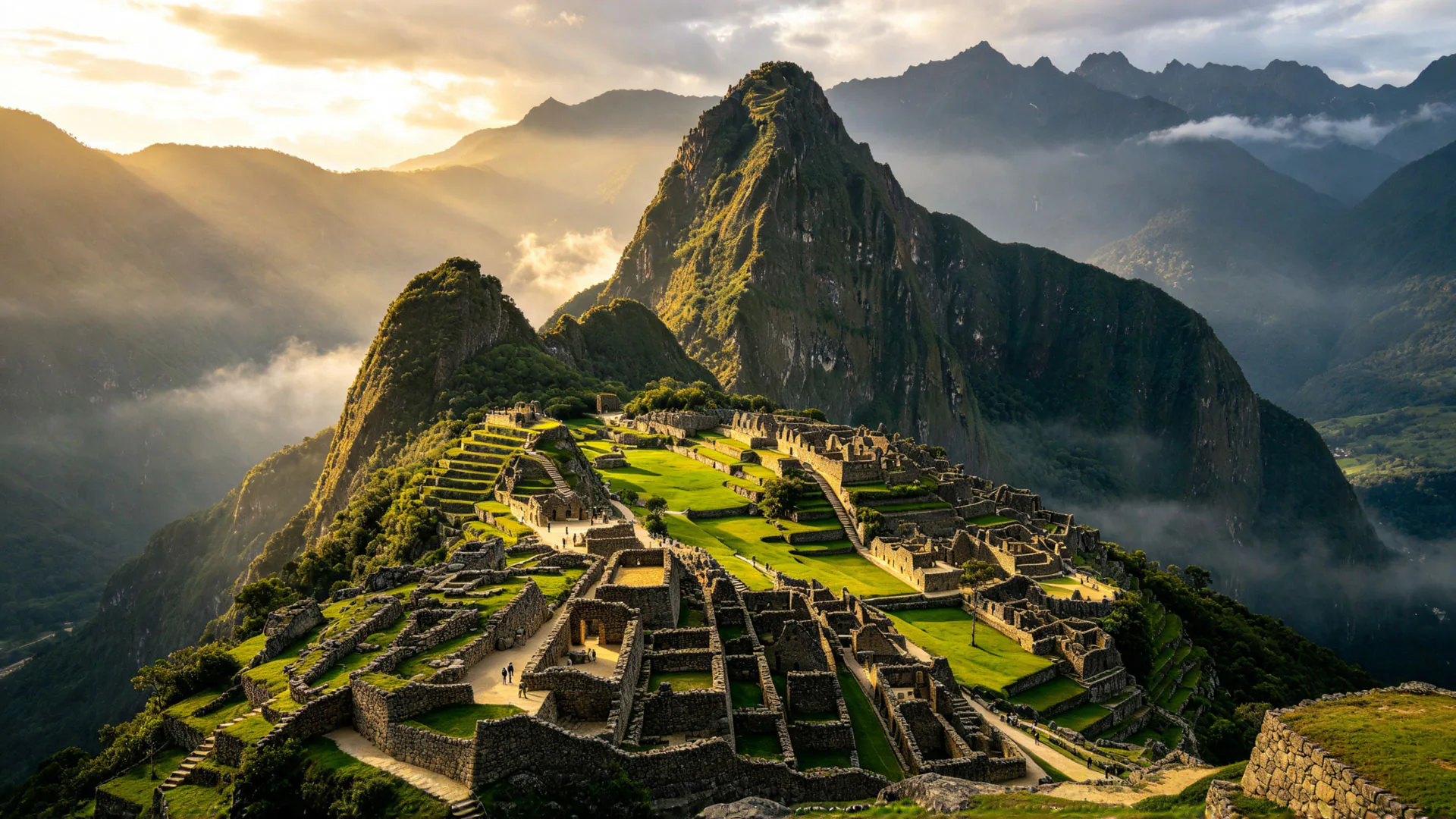
It is believed that Pachacuti Inca Yupanqui built Machu Picchu and that the city served as a royal residence. The city itself contained the royal residence, altars, temples, houses, fountains (there were 16 of them) and channels for draining and supplying water. Machu Picchu would not have been viable had the Inca’s superb builders and engineers not constructed a huge number of terraces to support that magnificent complex.
The terraces served as small farms, but their main role was to hold the mountain in place and prevent erosion. They worked as a kind of drainage and water filter, for the heavy rainfall, instead of causing landslides, seeped gradually into the ground. Inside the terraces there were several layers: soil on top, a layer of sand beneath it, then a layer of gravel and large stones. Although the site was demanding and hard to reach for building, two key things should be borne in mind: there was a spring of drinking water nearby, as well as large reserves of granite, so that Machu Picchu had its own quarry.