Unlike the Aztecs or the Inca, the Maya never formed a single empire with one ruler and one capital. Theirs was a civilization of dozens of city-states, settled in what is now south-eastern Mexico, Guatemala, Belize and the western parts of Honduras and El Salvador, whose development ran unbroken for more than three thousand years – from the first farming settlements around 2000 BC, through the brilliant Classic period (AD 250–900), right up to the present, for the descendants of the Maya still live in that same region and speak the languages of their ancestors.
City-states in the rainforest
The political map of the Maya world resembled a mosaic of dozens of independent kingdoms, each ruled by a k’uhul ajaw“Holy lord” – the title of the ruler of a Maya city-state, regarded as the mediator between his people, the gods and the venerated ancestors.. The cities were sometimes joined by marriage or alliance, but more often they fought one another, for trade routes, for farmland and, above all, for the captives needed for ritual bloodshed. The greatest rivalry of the Classic period was between the dynasties of Tikal and Calakmul, two huge cities in the lowland rainforests of present-day Guatemala and Mexico, whose conflict lasted for generations and drew a whole network of smaller allied cities in on both sides. In 562 Calakmul, allied with the city of Caracol, inflicted a heavy defeat on Tikal – the attack, as the inscriptions show, was timed to the position of the planet Venus, which is why archaeologists today call it a “star war” – and plunged it into more than a century of political eclipse, during which the city raised no new monuments.
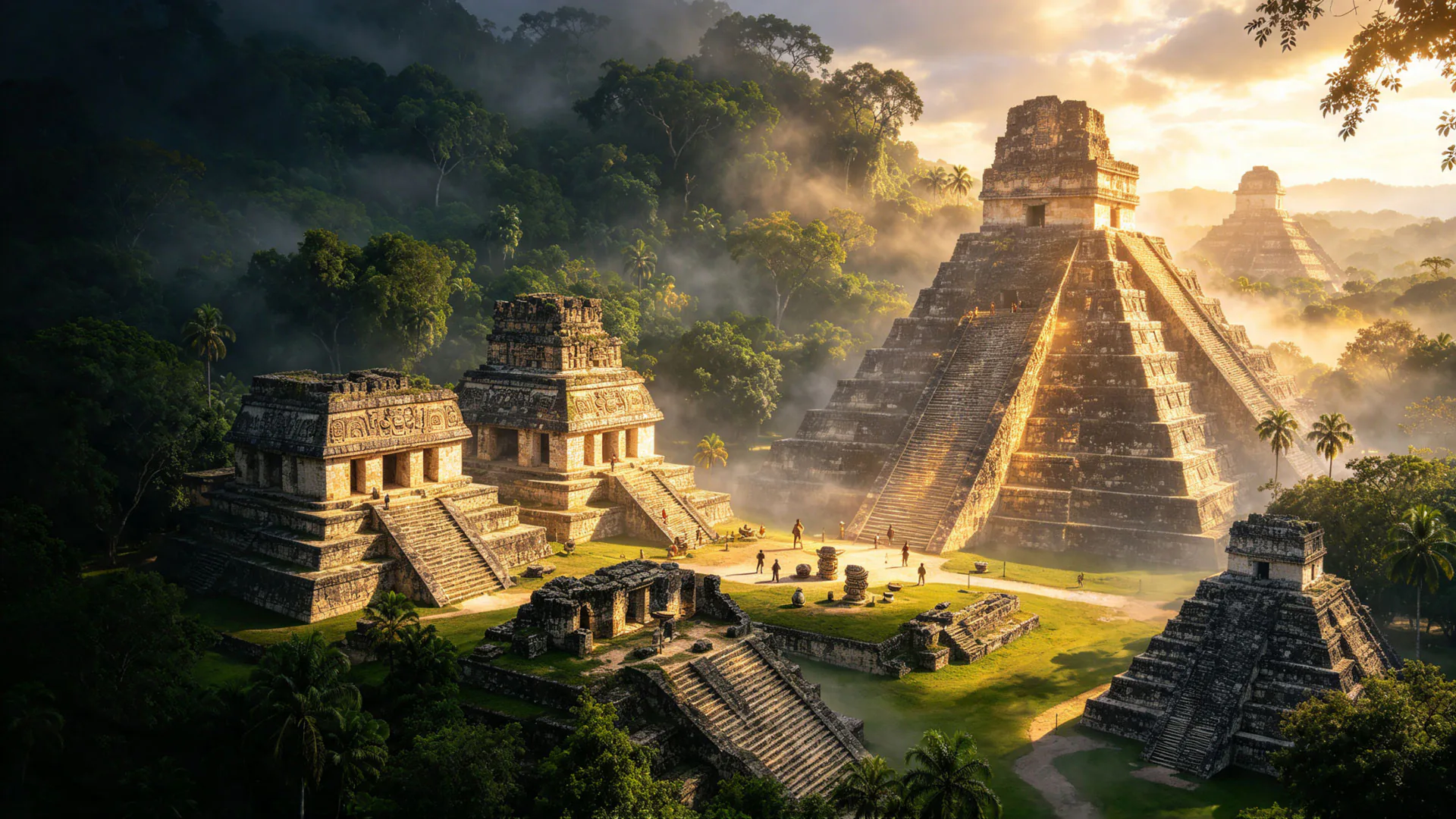
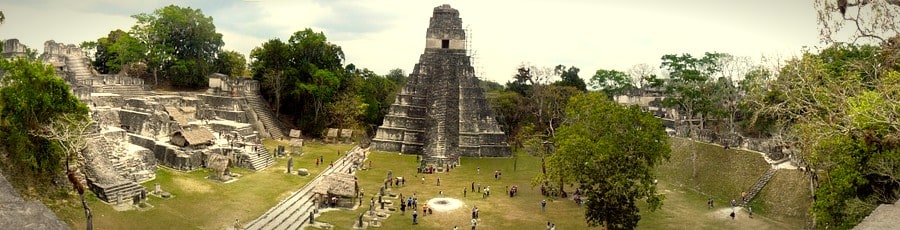
At the height of its prosperity Tikal probably had tens of thousands of inhabitants, with monumental temple-pyramids such as Temple I, built around 732 as the tomb of the ruler Jasaw Chan K’awiil I. Calakmul, Palenque, Copán and many other cities reached a similar scale, but none of them ever managed to subdue the others for good and establish a single Maya state – and it was precisely this political fragmentation that, centuries later, would make the European conquest much harder and slower.
A script that burned
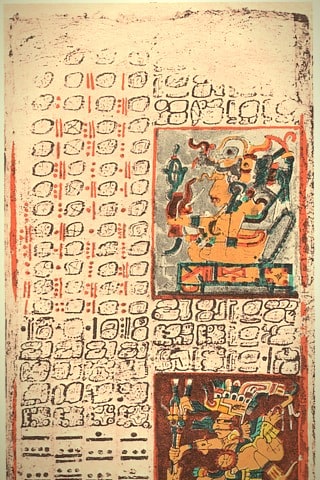
The Maya developed the most complex writing system in pre-Columbian America – a combination of signs for whole words and signs for syllables, several hundred symbols in all, with which they recorded historical events, the genealogies of rulers, astronomical observations and religious texts, carved in stone or written on long strips of fig-bark paper folded into books like a concertina.
Those books, the Maya codices, vanished almost completely thanks to Friar Diego de LandaDiego de Landa (1524–1579), a Franciscan friar and later bishop of Yucatán. In 1562 he burned most of the surviving Maya codices, but in a work in which he tried to write down the Maya script in Spanish letters he unwittingly left a clue that helped to decipher it centuries later., who in 1562, in the small town of Maní, burned dozens of them, convinced that they were “the work of the devil”. Only four codices survive today, named after the cities where they are kept – the Dresden, the Madrid, the Paris and the disputed Grolier – of which the Dresden, with its detailed astronomical tables, is the oldest and best preserved. The irony of history is that it was Landa himself, in the same work in which he justified the burning of the codices, who also recorded his attempt to interpret the Maya script by means of the Spanish alphabet; that “alphabet”, fundamentally misconceived, became centuries later one of the key levers for deciphering the script, when the Soviet linguist Yuri KnorozovYuri Knorozov (1922–1999), the Soviet linguist who in the 1950s, relying on Landa’s record, was the first to prove that the Maya script is largely phonetic, a syllabic script. recognized it in the 1950s as a partly phonetic record. The decisive advance came in 1960, when the art historian Tatiana ProskouriakoffTatiana Proskouriakoff (1909–1985), an art historian of Russian origin. In 1960 she showed that the inscriptions on the monuments record real historical events from the lives of rulers, and not only calendrical and religious data. proved that the inscriptions record not only astronomy and religious formulas, as had been believed, but also quite specific historical events – the births, accessions, wars and deaths of individual rulers.
Equally advanced was the Maya number system, based on twenty, which used a dot for one, a bar for five and a shell symbol for zero – so that the Maya, quite independently of the civilizations of the Old World, were among the first in the world to arrive at the concept of zero as a numerical value.
A calendar written in stone
The measurement of time was a true obsession of the Maya scholar-priests. In parallel they used a ritual calendar of 260 days, the Tzolk’inThe ritual calendar of 260 days (13 numbers × 20 day names), used alongside the solar year of 365 days called the Haab’., and a solar year of 365 days, called the Haab’, which, interlocked, repeated in a cycle of 52 years known as the Calendar Round. For recording longer spans of time and dating individual events exactly they used the so-called Long Count – a linear count of days from the mythical date of the creation of the world, which corresponds roughly to 11 August 3114 BC. It was the completion of one of the great cycles of the Long Count, on 21 December 2012, that popular culture misread as the announcement of the end of the world – for the Maya themselves it would have been merely the rolling over of a calendar counter, something like the moment when the odometer of an old car turns to a new row of five digits.
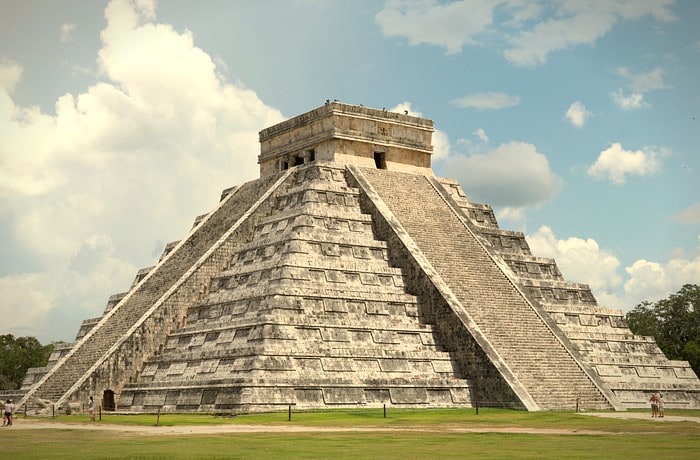
Their observation of the sky was just as precise. The Dresden Codex contains detailed tables of the movements of the planet Venus, whose synodic cycle of 584 days was calculated almost without error, and its positions were used, as we have seen, even for planning military campaigns. The pyramid of El Castillo at Chichén Itzá, in northern Yucatán, is itself a kind of calendar in stone: each of its four sides has 91 steps, which with the top platform makes exactly 365 – the number of days in the solar year. Twice a year, at the equinox, the setting sun casts a series of shadows along the edge of the stairway that joins the stone serpent’s head at the base, giving the impression of a serpent descending the pyramid.
Gods, kings and blood sacrifice
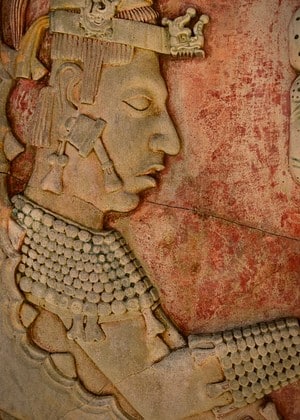
Rulers such as Pakal the Great, who governed Palenque for almost seven decades until his death in 683, were regarded as sacred mediators whose blood, it was believed, fed the gods and upheld the order of the world. In the rites of blood sacrifice the rulers and their wives pierced their tongues or other parts of the body with a thorn-studded rope or with stingray spines, and offered the blood to the gods by burning it on paper. One of the best-known depictions of such a rite – Lady Xoc of the city of Yaxchilan drawing a rope through her tongue while her husband holds a torch above her – is carved on a stone lintel now kept in the British Museum.
Religious life was also permeated by the ritual ball game pok-ta-pok, played with a heavy rubber ball on narrow stone courts with walls sloping like the letter V. The game had a deep cosmological meaning – in the sacred book Popol VuhThe “Book of Counsel” – the sacred book of the K’iche’ people, preserved in a manuscript from the early 18th century, with the myth of the divine twins and their game against the lords of the underworld. it is the scene of the duel between the divine twins and the lords of the underworld, Xibalba – and the losers, according to some depictions, sometimes paid with their heads. Equally sacred were the cenotesNatural limestone sinkholes filled with groundwater, common in Yucatán. The Maya regarded them as sacred entrances to the underworld, Xibalba., natural sinkholes filled with groundwater, through which, it was believed, one entered the underworld. In the Sacred Cenote at Chichén Itzá, explored by divers at the beginning of the 20th century, objects of gold and jade were found, as well as human bones, confirming the old accounts of victims thrown into its waters.
The fall of the cities and the collision with Europe
During the 8th and 9th centuries, for reasons that archaeologists still argue about, the great cities of the southern lowlands – Tikal, Calakmul, Palenque, Copán – one after another stopped raising monuments and were abandoned. Today it is thought that a tangle of causes was at work at the same time: long droughts, confirmed by the analysis of lake sediments and cave deposits, soil exhausted after centuries of intensive farming, overpopulation and ever more frequent wars between the cities, which probably shook the very idea of sacred kingship. Yet there can be no talk of a complete disappearance of Maya civilization – in northern Yucatán, cities such as Chichén Itzá, and later Mayapán, flourished for centuries more in the so-called Postclassic period.
When the Spanish reached the New World, it was that very political fragmentation, which centuries earlier had weakened the Maya cities from within, that made their conquest difficult. Unlike the Aztecs and the Inca, whose empires fell within a few years because it was enough to take a single capital, Yucatán had no such centre: the Montejo family began the conquest in 1527 and established full control over the peninsula only after almost twenty years of fighting. The last independent Maya kingdom, that of the Itza, with its capital Nojpetén on Lake Petén Itzá in present-day Guatemala, held out until 1697 – almost two centuries after the fall of Tenochtitlan and the Aztec empire.
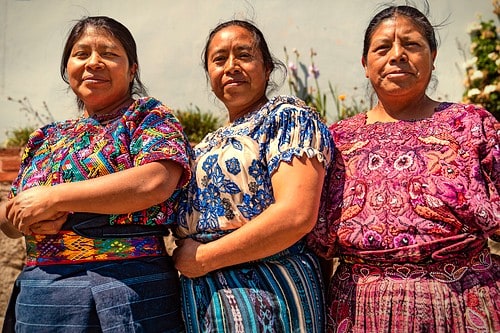
Contrary to the entrenched myth of a “vanished civilization”, the Maya never disappeared. Today more than six million of their descendants live in Mexico, Guatemala, Belize and Honduras; they speak some thirty Mayan languages, grow maize in the traditional way and, in many communities, still follow the old calendar – proof that the civilization which raised Tikal and Chichén Itzá did not die out but, like many of its cities before it, merely changed its form.