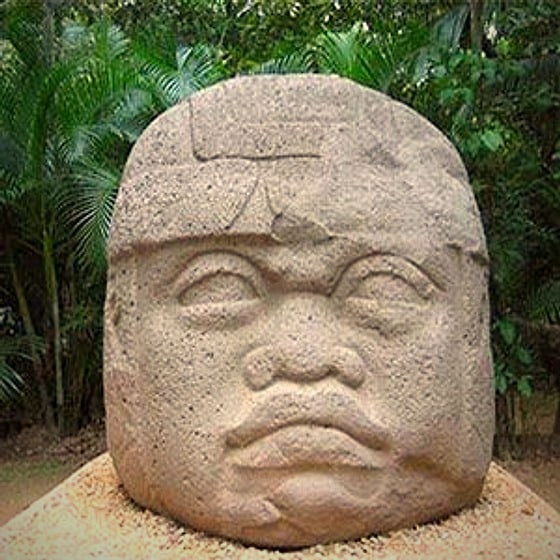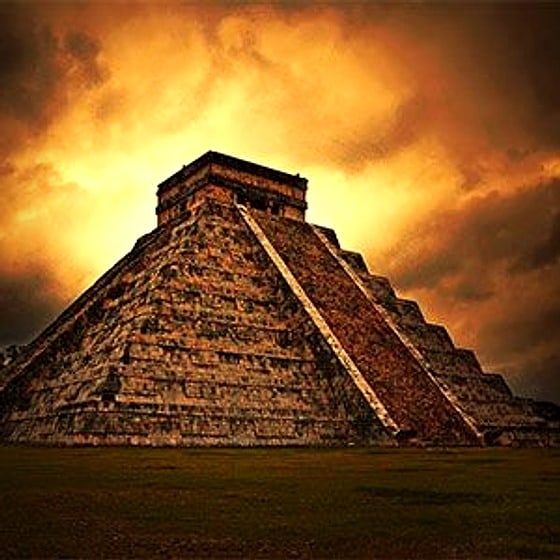
The origin of the Aztecs has never been fully explained. Legend has it that around 1250 a small nomadic tribe from the sacred land of AztlánThe mythical homeland of the Aztecs, “the land of the herons”, somewhere in the far north. Its exact location has never been established. settled in the Valley of Mexico.
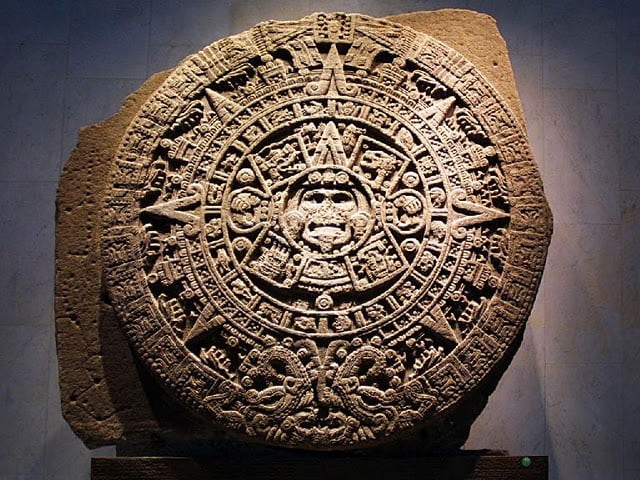
They had three names in their original NahuatlThe language of the Aztecs. More than a million people in Mexico still speak it today, and it gave us the words chocolate, tomato, avocado and chili. language: Mexica, Tenochca and Aztecs (after their land of origin, Aztlán, the land of the herons somewhere in the far north). Because of their skill as warriors, the peoples living in the Valley of Mexico hired them as mercenaries. Over time they became an ever stronger power, which as early as the 14th century conquered Azcapotzalco (a city on the shore of Lake TexcocoA large shallow lake in the Valley of Mexico. Tenochtitlan grew up on its islands. The Spanish later drained the lake, and Mexico City now lies on its bed. that had ruled the area until then).
Two stories tell of the very beginnings of Aztec ferocity in war. The cities of Azcapotzalco and Culhuacan allowed the Aztecs to settle in the rocky district of Tizapán. The area was full of poisonous snakes, and the cities hoped to be rid of them that way. Almost certain that the snakes had finished the Aztecs off, they set out for Tizapán after a while. Instead of the sight they had hoped for, they found them alive and in perfect health, helped by a diet rich in protein, which they got by eating the snakes.
The second example comes from the time when they were a mercenary army. Suspecting that a trap was being set for them, they ingeniously and brutally cut one ear off each of the captives they had taken. When the captives were counted and other groups of warriors tried to claim the Aztec prisoners as their own, they produced a sack full of ears as proof that the prisoners were theirs.
Everyday life
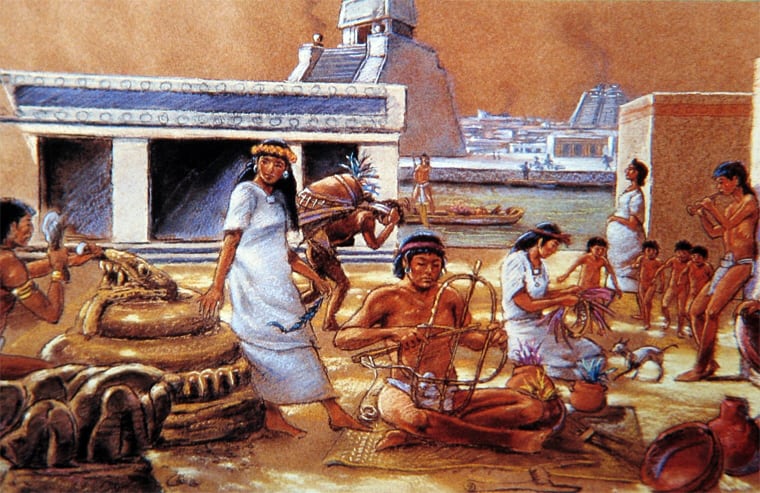
As in the modern world, the day began at early dawn. From the tops of the city’s temples the hollow clatter of sea shells rang out at regular intervals, together with the sharp beats of the teponaztliA wooden gong: a hollowed log with two tongues on top. Striking them gives two different tones; it was used in ceremonies, in war and to mark the time of day. (a wooden gong), marking the passing of the parts of the day and night.
The usual daily fare consisted of a light snack, a hearty meal at noon and another light meal at dusk. The main source of food was the colourful city markets with their rich supply. Maize was the most important foodstuff (its flour was made into the most common product, the tortilla), along with peppers, beans, squash, potatoes, tomatoes and various kinds of fruit. For food they raised turkeys and dogs, and they ate insects such as the worms that live in the agave, grasshoppers, ants and other larvae.
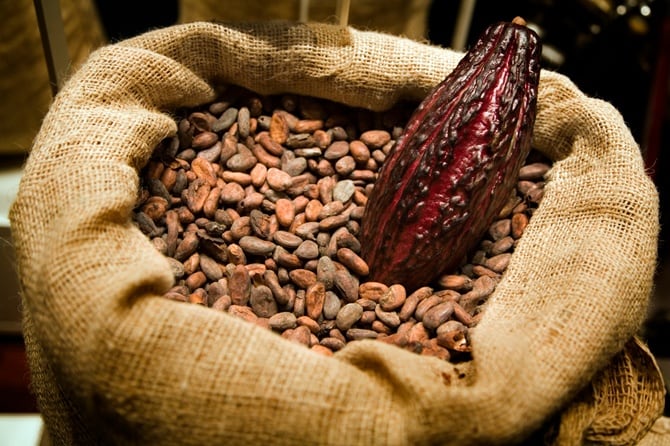
The market was the place where food was supplied and redistributed (cacao beans were one of the means of payment). It was also under the watchful eye of overseers and of a court that punished even the smallest offences severely and on the spot. Most offences were punished by death, such was the importance attached to obeying the law, however trivial the deed may look from our point of view. The laws were harsher towards the aristocracy than towards common people (which could hardly be said of the postmodern age). Occasionally someone was pardoned, but the offender had no right to a second mistake: the penalty was almost always death.
One of the best-known examples is the sentencing of Chalchiuhnenetzin, daughter of the ruler of the city of Texcoco, NezahualpilliNezahualpilli (1464–1515), ruler of Texcoco, one of the three cities of the Triple Alliance. He was known as a poet, astronomer and sage. (1472–1515). The future queen took to changing lovers, whom she later killed, until it all came to light. The punishment, of course, was execution, regardless of her high rank.
For drunkenness nobles were sentenced to death, while commoners were punished by having their heads shaved and being publicly ridiculed. The death penalty could not be avoided by traitors, murderers (including women who had aborted a child, and everyone who had helped them), or those who committed incest or rape. The punishment for adultery was strangling for the woman and stoning for the man. No one was allowed to take punishment into their own hands outside the official court.
As for kinship among the Aztecs, it can be roughly divided into two categories: monogamy (the common people, who became full members of society by founding a family) and polygamy (which belonged to the high nobility and the rulers, and essentially served the political purpose of forging alliances). Among common people, the main say in the choice of a spouse belonged to the parents of the future couple. Once a young man’s family had chosen a girl, they went to a priest, who used their dates of birth to determine whether the future spouses were compatible and what fate awaited them.
Religion and sacrifice
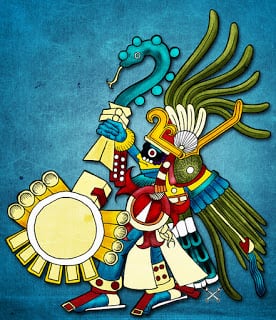
The whole of Aztec culture is steeped in religion and belief. Their pantheon holds numerous deities inherited from other Mesoamerican peoples. To understand their complex religious system we would have to twist not only our tongues but our minds as well. We shall of course not do that, but we shall look at some of the most important:
Ometecuhtli – One Aztec creation myth speaks of this god as the supreme creator of the earth and of the other gods. He was known as the god of duality and had a two-sexed nature, a male-female character. The male was called Ometeotl and the female Omecihuatl.
Huitzilopochtli – The earth goddess Coatlicue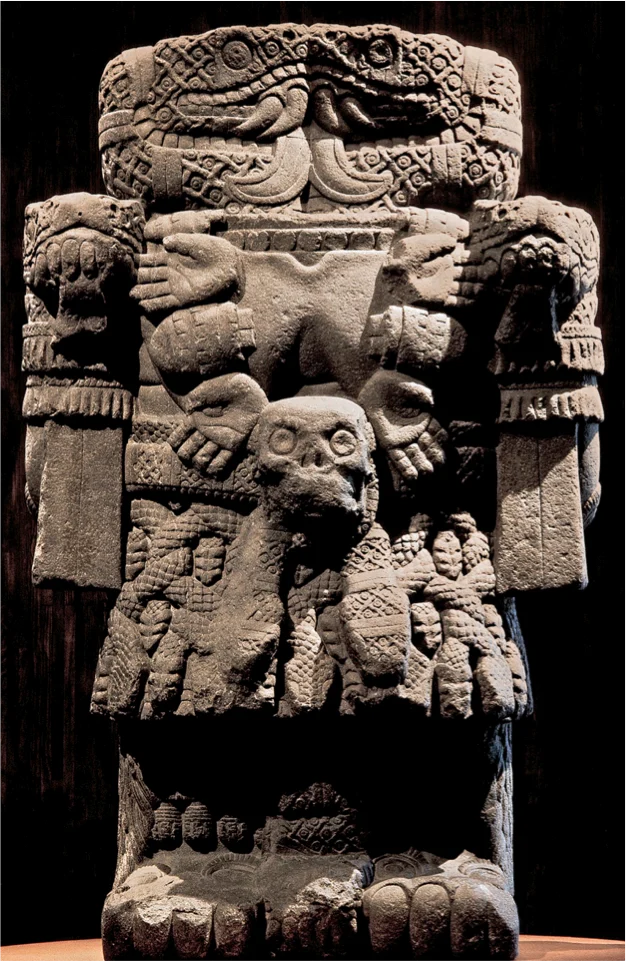 Coatlicue The earth goddess, “she of the serpent skirt”. The stone statue, 2.5 m tall, is now in the National Museum of Anthropology in Mexico City. had one daughter, Coyolxauhqui (the moon goddess), and countless sons (the Four Hundred Southerners). When Coatlicue became pregnant with the future god of war, her daughter gathered the rest of the brothers and persuaded them to punish their mother with death, considering her promiscuous. As they attacked their mother, Huitzilopochtli emerged from her womb painted blue, holding a fire serpent with which he cut down Coyolxauhqui and the other brothers.
This myth speaks of the supremacy of the sun, represented by Huitzilopochtli, over his sister Coyolxauhqui, who represents the moon. His mother Coatlicue is the earth with the skirt of serpents from which the sun rises every morning. And Huitzilopochtli’s brothers, the Four Hundred Southerners, are the stars in the sky that scatter each morning as the sun begins to rise. On top of the great pyramid of Tenochtitlan (which had two tower-shrines dedicated to Tlaloc and Huitzilopochtli) burned an eternal fire dedicated to Huitzilopochtli. It was never allowed to go out, for otherwise Aztec power and supremacy over other peoples might vanish.
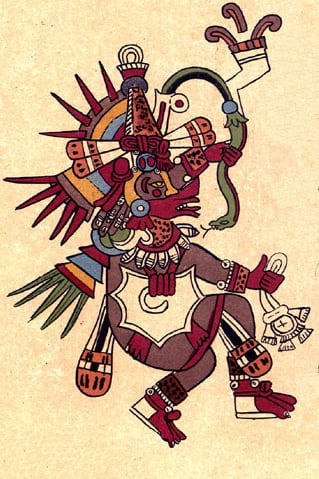
Tezcatlipoca – God of fate and war, the bringer of discord and vice. He has been compared with the Christian Lucifer, and in some versions he is also regarded as the creator of the earth. The cult of Tezcatlipoca goes back to the time of the ToltecsThe people who ruled central Mexico from the 10th to the 12th century, with their capital at Tula. The Aztecs regarded them as a model and as their ancestors.. They told the story of a mirror of dark obsidian glass in which the future and people’s intimate fantasies could be seen. In a time of famine Tezcatlipoca, also called the “God of the Smoking Mirror”, hid the mirror in order to prolong human suffering. He was the patron of secret night-time activities such as adultery and theft.
Tlaloc – God of rain. Tlaloc’s name comes from the word tlalli, which means earth in Nahuatl, and the suffix oc, which denotes something that stands above. A literal translation: he who is above the earth. He was honoured with the sacrifice of human blood (mostly of children and the young) at the festival of Atlcahualo. His cult was closely tied to the fertility of the land.
Quetzalcoatl – God of the air and of wisdom, teacher of the arts of peace. Translated from Nahuatl, Quetzalcoatl has a double meaning, “Feathered Serpent” and “Precious Twins”. He was the patron of the ruling family, which is why its members often wore feathers of the quetzalThe quetzal is a bird with brilliant green plumage and a tail up to a metre long. Its feathers were more precious than gold and only rulers and nobles were allowed to wear them.. He was regarded as the inventor of the ritual calendar, the teacher of farming and the patron of craftsmen. He is one of the few Aztec deities who did not demand human sacrifice.
Many myths tell of his conflict with the dark god Tezcatlipoca. One of them relates how Quetzalcoatl summoned all the snakes of the coast (the Gulf of Mexico) and made a raft of them, on which he returned to the land he had come from, Tlapallan. Since Quetzalcoatl was believed to be due to return the same way he had left, a coincidence occurred that proved fatal for the Aztec empire. Instead of the god of wisdom, it was Cortés and his conquistadors who landed on the shore of the Gulf of Mexico. He arrived in the very year (One Reed) in which, according to the prophecy, Quetzalcoatl was to come, and so the conquerors were mistaken for gods.
The ritual of sacrifice
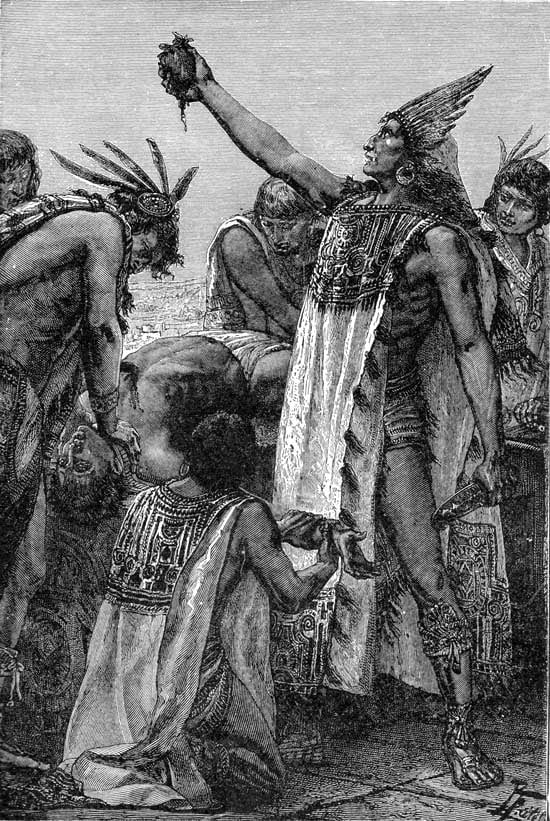
The Aztecs were not the first to practise ritual sacrifice; they took it over from other Mesoamerican peoples and raised it to the highest possible level. Offering a human sacrifice was a religious duty, a need for sustaining the world, preserving the fertility of the land and the power of the ruler. The gods, who could end and destroy the world at any moment, had to be satisfied.
Among the Aztecs there were two most common forms of sacrifice: one was cutting the heart out of the victim’s chest, the other death by burning. The priests would lay the victim on the eagle stone (cuauhxicalliA stone vessel, often in the shape of an eagle or a jaguar, in which the hearts of the sacrificed were placed. It was called the “eagle vessel”.), which was pointed, so that the victim arched his back and the chest was in a good position for the heart to be removed more easily. The torn-out heart was always turned towards the sun and then thrown before the figure of the god for whom the sacrifice was intended. The bodies were thrown onto a bloody heap at the foot of the stairway. Later they were collected and prepared for cannibal feasts.
Sacrifice by burning was reserved for the fire god Xiuhtecuhtli. Besides these two main methods there was also sacrifice in honour of the god of sowing and vegetation, Xipe Totec. The victims were killed with arrows so that their blood ran into the ground like water that gives life to the earth (the Aztecs called human blood chalchiuatl – precious water). The corpse was then flayed, and the priest wore the skin of the flayed victim.
In 1487 the emperor Ahuitzotl opened the great temple of Tenochtitlan (Templo MayorThe Great Temple at the heart of Tenochtitlan, a double pyramid dedicated to Huitzilopochtli and Tlaloc. Its remains were discovered by chance in 1978, in the middle of Mexico City. – the temple dedicated to Huitzilopochtli and Tlaloc) with an enormous ritual sacrifice. The chronicler Fernando de Alva Ixtlilxochitl described the event as “a slaughter without equal in the history of mankind”. The great ceremony lasted four days. According to some sources, 80,000 people were sacrificed during it. The first sacrifice was made by Ahuitzotl himself, plunging an obsidian knife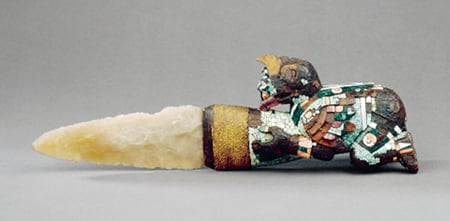 Ritual knife A blade of obsidian, volcanic glass sharper than steel. The handle is decorated with a mosaic of turquoise and shell. into the victim’s chest and taking out the heart, which he offered to Huitzilopochtli’s new altar.
Warfare and military life
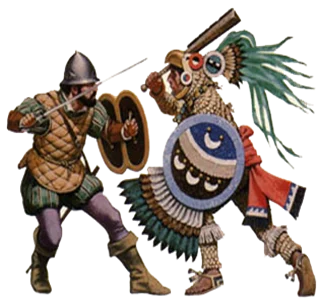
For the peoples of Mesoamerica warfare was a natural state and their way of life. War meant securing resources, supremacy over other peoples, slave labour, and slaves destined for sacrificial rituals.
One of the famous forms of warfare was the xochiyaoyotl (the Flower Wars). These were battles arranged in advance, with the consent of both warring sides. In them warriors could take live captives for ritual sacrifice and perfect their skill in war. Here, then, two armies fought each other without either breaking into the other’s city. The name itself, Flower Wars, is probably connected with the ceremony that followed the battle. The people celebrated their warriors by carrying them in procession, forming the shape of a wreath of flowers. The Flower Wars were waged alongside the usual kind of warfare.
To rise in the military hierarchy, a warrior had to distinguish himself by courage in battle and bring back as many live captives as possible. The elite Aztec units were the eagles and jaguarsThe two most celebrated warrior orders. Only warriors who had captured at least four enemies were admitted. The eagles wore helmets in the shape of an eagle’s head, the jaguars a costume of jaguar skin.. The Aztecs had no standing army; the army was raised as needed. Each city or city district had to provide about 400 soldiers, commanded by their local leader. These were grouped into larger units of about 8,000 warriors. For great campaigns as many as 25 such divisions were assembled, which made about 200,000 warriors in all.
For weapons they had small spears, clubs Macuahuitl A wooden sword (or club) edged with obsidian blades. It was the characteristic weapon of Mesoamerica; according to Spanish chronicles, it could bring down a horse with a single blow. set with blades of obsidian, volcanic glass, the atlatlA spear-thrower: a wooden shaft with a hook at the end, which lengthens the arm and gives the spear much greater speed and range. The Aboriginal peoples of Australia used it too. (an ancient weapon, a dart-thrower) and a shield made of hide.
The fall of Azcapotzalco and the ritual killing of its king Maxtla in 1428 marked the end of the Tepanec empire, and the rule of the Triple Alliance was established. The alliance consisted of Tenochtitlan, Texcoco and Tlacopan. They were the main driving force of Aztec expansion, controlling a great empire in the making.
Tenochtitlan – rise and fall
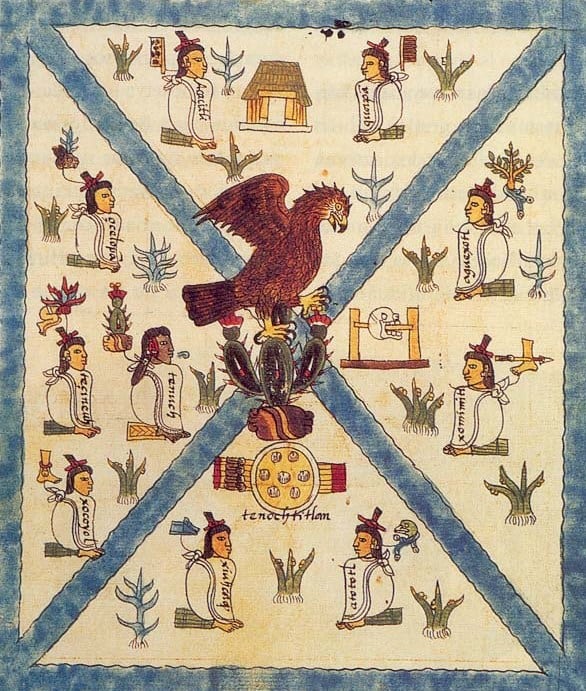
One of the legends tells of the founding of Tenochtitlan, the city on which the metropolis of Mexico City stands today:
Go at once and find the cactus (tenochtli) on which an eagle sits content. There we shall settle, there we shall rule, there we shall conquer with our spear and shield. There our city of Mexico-Tenochtitlan shall be, there where the eagle cries, spreads its wings and eats, where the fish swim. There where the serpent is devoured.
Huitzilopochtli, god of war and of the sun, to the high priest Cuauhcoatl
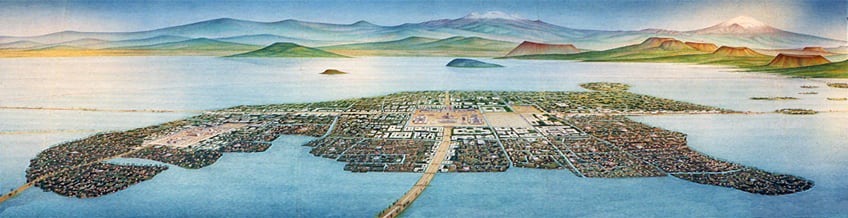
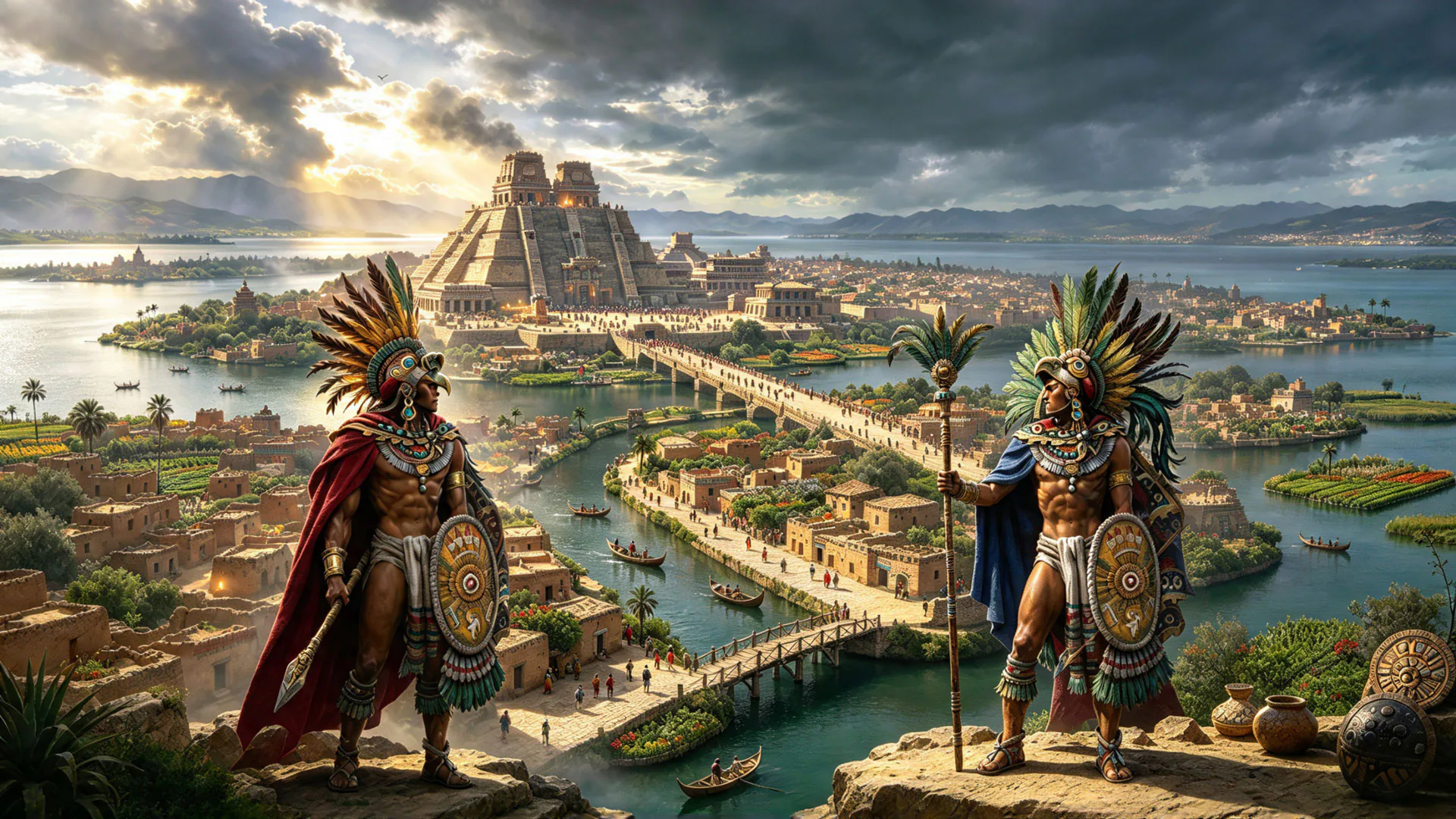
And so in 1325, on Lake Texcoco, one of the more beautiful cities ever made by human hands was founded. Surrounded by water, it spread over all the islets and sandbanks. Houses were built on piles above the water and along the lake shore. For want of farmland they built the famous chinampasFloating fields: rectangular beds of mud and reeds, anchored with willows in the shallow lake. They were so fertile that they gave up to seven harvests a year. (floating fields). The area of a chinampa ranged from 100 to 850 m².
In the centre, where the main ceremonies were held, stood the great pyramid dedicated to Huitzilopochtli and Tlaloc. At the great city market you could meet some 50,000 people. The city itself had a little over 300,000 inhabitants. They built small single-storey houses, drawbridges, schools and temples, and they had steam baths too, for they set store by hygiene, unlike the newcomers from Europe. They also built aqueducts that supplied the city with drinking water. Little did they suspect that one day the conquistadors would surround the city and cut off the water supply, which would be the end of them.
Stories of pyramids bigger than those of Egypt, of great quantities of gold, silver and precious stones, reached Cuba and fired the imagination of the Spaniards there. Among the most interested was Hernán Cortés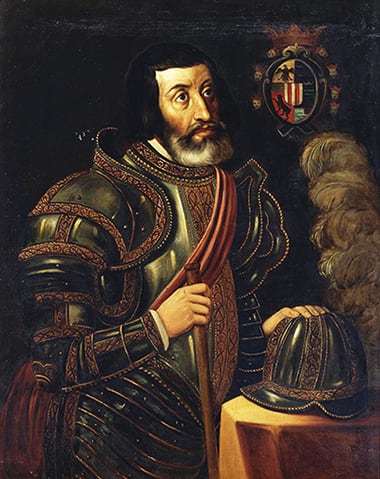 Hernán Cortés 1485–1547. The Spanish conquistador who, with a few hundred soldiers and thousands of native allies, brought down the Aztec empire., the mayor of a small Cuban town. He managed to obtain approval and funds for his expedition to Mesoamerican soil. He sailed from Cuba on 10 February 1519 with 508 soldiers, 100 sailors and 16 horses. He landed near the city of Tabasco. To prevent desertion and wavering among his soldiers, he scuttled the ships, so that no one could return to Cuba.
On the way to Tenochtitlan, Cortés managed to win over discontented and subjugated Mesoamericans. His chief ally was the city of TlaxcalaAn independent state east of the Valley of Mexico that the Aztecs never managed to subdue. The Tlaxcalans were their greatest enemies and gave Cortés tens of thousands of warriors.. When they reached Tenochtitlan, Moctezuma IIMoctezuma II (c. 1466–1520), the ninth ruler of Tenochtitlan, on the throne from 1502. Under him the Aztec empire reached its greatest extent. received the Spaniards in his capital, and for months they moved freely about the city. After a while the guests seized Moctezuma and held him hostage. A revolt broke out in the city, and when Moctezuma appeared in order to calm his countrymen, he was met by a hail of stones; he died of his wounds a few days later.
Cortés and his conquistadors gathered as much gold and silver as they could carry and fled the city by night, to their allies in Tlaxcala. Six months later, with reinforcements from the coast and a large Tlaxcalan army, they succeeded in destroying Tenochtitlan. For the attack he used 13 small ships that he had built in the meantime. He cut off the supply of drinking water and so weakened the defenders, whom he attacked from the water, destroying not only the city but the Aztec empire as well.
“The flag of Mexico shows an eagle perched on a cactus, devouring a serpent.”